Monday, May 20, 2019

Broken Chain: Bonanza Steakhouse, Tupelo, MS

Today's post highlights Lee County, MS, retail.


Hi everyone - welcome to the first Mid-South Retail Blog post of summer 2019! (Well... close to it, anyway. Memorial Day weekend, the unofficial start to the season, is still a few days away, but hey, it never hurts to get a head start!)

You'll note that today's post again falls under the Lost Histories of Mid-South Retail banner, but if you look closely at my graphic, you'll see a new component: this post is labeled specifically as "Broken Chains Edition." The term "broken chain" comes from the Broken Chains Blog, operated by Zap Actionsdower, a super talented author as well as a connoisseur of meals from restaurants that meet the namesake definition. Zap first articulated this definition, incidentally, in a post describing the history of Bonanza and Ponderosa (the former of which will be our subject today):

A business which, at some point in its history, had multiple, similarly-functioning, physical locations where a customer could purchase goods and/or services, and which presently has a significantly diminished presence and/or value as a brand compared to the same brand in its heyday.

This definition need not apply exclusively to restaurants, of course. But it does seem that restaurants are the more prevalent retail subcategory to meet the definition of a broken chain, and where restaurants are indeed concerned, very commonly if the chain in question is "broken" enough, there is very little corporate oversight (if a "corporate" even remains at all!). This, in turn, means that the local operators are left to run their restaurants as they see fit, which can result in varying menu items, food qualities, and general atmospheres - sometimes to high degrees - at locations that otherwise bear the same name. If the remaining outposts are far enough apart, locals may not even realize that other restaurants which bear the same name actually exist... but if they do ever happen to encounter one such additional "link" in the broken chain (as it were), they would likely be in for a surprise at all the differences they would experience!

If you're not yet familiar with the Broken Chains Blog, I highly recommend you subscribe to it and regularly check out Zap's posts. Like, seriously. If you could only fit one more blog into your reading schedule, I'd tell you to choose his over mine. It's that good.

...That said, I of course hope you've got enough room to read both of our blogs (!), and to that end I would like to mention that I do have a handful more of these "Broken Chains Edition" Lost Histories posts up my sleeve for future entries. I'm using the term with permission from Zap, who told me, "I'd be into the term 'broken chain' entering the vernacular to refer to the types of places I like to visit and write about." (Since that time, he has gone on to create an online store featuring fancy merchandise capitalizing on the blog's name, so I hope he's still good with that decision!) For those of you who are already familiar with Zap's blog and have been for a good while now, perhaps you'll recognize that my use of a styrofoam cup in my new graphic above is an homage to the previous Broken Chains Blog header image, before Zap adopted a new, dedicated logo.

The image of the Tupelo Bonanza that was used on the official Bonanza website's store locator page. Courtesy Bonanza Steakhouse

With all that out of the way, let's now move into today's subject: the final Bonanza Steakhouse to be located south of the Mason-Dixon Line. Owner John Mason opened the Tupelo, Mississippi, Bonanza Steakhouse in 1973, one of twelve locations he would ultimately operate at one time. Mason in 1989 even became an area developer for the brand, but over the years sold his other restaurants, leaving the Tupelo location his last. The Bonanza brand, founded in 1963 and boasting around 600 locations at its peak, similarly expanded and contracted in the decades that followed (and experienced several ownership changes and a Chapter 11 reorganization to boot; for more on the chain's history, reference Zap's post linked earlier), and by 2016 the Tupelo restaurant was one of only twelve left nationwide. Northeast Mississippi Daily Journal writer Dennis Seid ran a profile on the restaurant at this time:

The Bonanza brand - now officially called Bonanza Steak & BBQ - is owned by Homestyle Dining, based in Plano, Texas. [In 2017, after Seid's article was written, ownership changed hands to FAT Brands - ed.] But the company's reach only comes so far. 
"We've basically been on our own," said owner John Mason, who was once the largest Bonanza franchise owner in the country. 
...
"They don't give a whole lot of direction, but they'll argue with you," Mason said with a laugh, referring to Homestyle. "But they do supply us with some things through their purchasing program, including being on a national meat contract."
But because of the distance between Tupelo and Texas, as well as the other remaining locations, Mason's 160-seat store has pretty much been allowed to run almost autonomously. 
"We still pay our royalty check every month: in fact, we've never missed a payment; we've never not paid a bill," Mason said. "I'm pretty proud of that."

Obviously, then, it is clear that the Tupelo Bonanza serves as a prime example of a broken chain: the parent company gave little oversight, remaining locations were few and far between, and each individual restaurant had a fair amount of leeway in how they ran things. The fact that they were able to operate for so long, with increasingly diminishing corporate support, indicates that Mason and his Tupelo cohort - including general manager Marshall Cotton, who had been there for 41 years; steak chef Albert Fears, who had been there since the very beginning in 1973; head prep cook Gaye Edwards, who had been there for 35 years; and more - had found the recipes, literally and figuratively, for success. This leeway and comfort with their longtime, popular approach is further demonstrated in the restaurant's response to a potential challenge which arose in 2015 when Homestyle Dining "announced a 'new era' for Bonanza with a menu that offered more southern-style barbecue offerings in addition to its famous steaks" and sought to "'transform [Bonanza] into a modern, full-service concept' built around a butcher house theme." As Seid reported, the Tupelo Bonanza was unfazed:

Mason and Cotton didn't blink. They know their customers and what they expect and haven't adopted all the changes. ... Diners still walk through a line at the Tupelo Bonanza, where they pick up a tray and silverware, order off the big menu board and pay at the end of the line. Their orders are brought out to them not long after they come off the grill. 
"People are used to that," Cotton said. "We've stuck with what has gotten us here. I guess you could call us mavericks."

The article also notes that "Mason leaves the day-to-day operations up to Cotton," saying, "This is his as long as he wants it. If there ever comes a time we can't pay the bills, it'll be time to close."

I'm not sure if the time where they couldn't pay the bills ever came. But the time to close did nevertheless.

Courtesy Dennis Seid

On August 22, 2018, accompanied by the above photo of the restaurant's exterior, Seid posted to his BizBuzz blog the news that "After 45 years, Bonanza Steakhouse in Tupelo is winding down." By this point, Bonanza had whittled down to only ten locations in the continental US, and following Tupelo's closure as well as one in Lincoln, Illinois, in the same timeframe, would wind up with just eight present-day. Here is an excerpt from Seid's report explaining the decision to close:

Owner John Mason confirmed that the building is under contract to be sold to Dollar General Corp., which has filed plans to build a store on the property at 550 N. Gloster St. in Tupelo. 
"It's not a done deal, but it's all but finished," said Mason, who opened the restaurant in 1973. "We've been working on it since about January, and they'll have to tear the building down." 
Plans have been filed with the city's planning department by Dollar General, which estimates construction cost of around $900,000. 
... 
[Mason] admits the concept has gotten old, and diners' tastes and habits have changed. 
"It's time to go," he said. "It really is bittersweet. This has been a great store for us." 
Employees have been told of the impending closure, but Mason said most have taken it well and have remained on the job. There's no timeline as to when the restaurant will close and when Dollar General will take over the site.

As it happens, that time would arrive just one month later, when on September 24, 2018, the Tupelo Bonanza posted to its Facebook page, "This is our final week." (Unfortunately, the Facebook page has since been disabled, but their Twitter post remains intact.) Wrote Seid, "The restaurant plans to close Sunday [September 30, 2018] but could shut down earlier if the remaining inventory runs out."

Screengrab from a news report on Bonanza's closure. Courtesy WTVA

Roadside sign at the Tupelo Bonanza, as seen in 2014. Courtesy SomePhotosTakenByMe on flickr

The news of Bonanza's closure was so big, evidently, that it even made it into an Associated Press article. A further, final article by Seid serves as one last profile of the restaurant and, in particular, its loyal employees and customers, as well as the relationships that had developed among them all. I won't quote much from this piece - besides to say that Mason elaborated "It's a good decision, especially with my health, and I'm 84" - but I do encourage you to read it for yourself here. Perhaps the final lines of that article serve as the best summary of the bittersweet nature of the closure:

"I've even taken Albert fishing," [longtime customer Johnny Bevels] said. "I got his phone number so I could take him again." 
It's that kind of friendship and loyalty that the folks at Bonanza have long fostered and appreciated, which makes closing the restaurant that much more difficult. 
"You try to find words, but you don't know what to say," Cotton said. "We all realize it's time ... I hate we have to do what we have to do, but it's really hard. All good things come to an end."

--------------------------------------------------


I first encountered the Tupelo Bonanza in the summer of 2016, snapping the above drive-by photo as I passed the restaurant. I was immersed enough in the retail scene at this point to understand that Bonanza - and its sister brand, Ponderosa - was (were) becoming increasingly rare, but I was not familiar with the significance of the Tupelo location specifically (it being the last remaining Bonanza south of the Mason-Dixon Line), nor was I aware that the number of Bonanza restaurants totaled in at a mere twelve (at that time) within the continental US. Two years later, upon learning of the Tupelo location's impending closure - and having become more well-versed in the magnitude of the situation - I made sure to travel down to Tupelo on September 7, 2018, to visit the restaurant. My photos follow.


These first images are some views from the road as we approached the restaurant. I visited here with my parents for a nice family meal - that seemed in line with the atmosphere of Bonanza as I had heard it described in those articles I'd read beforehand. We had been putting off the visit for a little while, given that there was no sense of urgency (after all, up to this point the only news was that they'd be closing eventually, with no timetable put in place yet and an assurance that "It's going to be business as usual until we hear otherwise"). I'm very grateful we went when we did, as it would be mere weeks later that the restaurant would close for good, with relatively short notice (at least, as it applies to an out-of-towner who only has the weekends free for such a trip!).


The side of the restaurant is rather nondescript compared to the front. Parking could be found on either side of the building, but was limited in front, as the building was placed extremely close to the street. Whether this was always the case or if the road had simply expanded in width over the years, inching closer to the building, I'm not sure.


Some views of the front of the building show how close the road sign is to the storefront, and the proximity of the street as well. This building is clearly done up in a recognizable barn style commonly used by Bonanza restaurants around the country, although I doubt this is the only style ever used by the chain. Does anyone know if this is the original style, or if the first buildings bore a different design? Given that this building opened ten years after the chain's founding, I feel it could go either way on that front.


Entering the restaurant, you are herded into a small vestibule. The exit door opens into the vestibule on the left, so the only other option is to hang a right. Doing so takes you down a defined corridor around the front right corner all the way to the back right corner, where the order counter is located. Along the way you pass the specials board (the second image above). At the order counter itself, the true menu board can be found (the third image), as well as a fun "Welcome Pardners" sign, to go with the Western motif. (Bonanza, of course, is based on the TV show of the same name.)


These are some (attempted) views from the corridor/order line into the main dining area. It's rather difficult to describe this restaurant's layout in full, but I'll try my best... Imagine a smaller square within a larger square: the smaller square comprises the hot food bar, salad bar, and a limited selection of seating, while the outer ring (as it were) formed by the larger square is the pathway from the entrance, to the order counter, to the exit (moving counterclockwise). Additional seating could be found in separate "rooms" located in offshoots from this main area, but I unfortunately did not explore those thoroughly, as we chose to sit in this central area in order to be close to the food bars (which are what we had chosen and paid for as our meals).


Speaking of payment, that took place at the end of the order counter, in the back left corner of the "squares" I described above. The progression went from placing your order, to filling your drinks and picking up a tray, to paying at the register, running from right to left along the rear wall. Sadly, my image here came out thoroughly blurred, but I thought it was interesting to see the "newer" Bonanza logo present here, since so much of the restaurant's décor seemed to still be stuck in the 1970s!


On that note, here are some views from within the "inner square," showing the salad bar as well as some of the cool, unique décor, surely dating back to the restaurant's opening day. This includes two awesome stained glass panels engraved with the brand's first initial, as well as a large BONANZA logo placed on that overhang above the order counter. Oh - and wood paneling. Lots and lots of wood paneling.


We took our seat in the very back right booth available, affording me a good overview of the central dining area and food bars, as well as that logo'd overhang if I twisted around to take a look at it. I won't lie - the lighting inside this place was dim enough to interfere with the quality of my photos. But regardless, I think all in all they turned out fairly well. I definitely wanted to be sure to document as much of this place as I could, with both this location closing and the brand in general being a dying breed.


Courtesy Google Maps

Image source unknown


Since they of course are the stars of the show food-wise, here are some views of the hot food bar and the salad bar. (Sadly, I did not get any good pictures of the dessert bar, which was placed right next to the hot food bar.) They all were pretty immaculate, and well-stocked insofar as none of the food containers seemed empty. I also thought the "Country Charm" buffet unit used for the hot food bar was interesting, the way the food containers were simply placed within the open space rather than into specific, defined compartments, as in the salad bar.


I'm no Instagrammer, but I thought I'd be remiss if I didn't share with y'all some pics of the delicious food I enjoyed while I was here! I realized halfway through my first plate from the buffet that I forgot to take a picture of it beforehand, so I was forced to go back for a second plate in order to get the top photo... oh darn :P  Of course, by the time I finished that plate I was pretty full, but I still didn't want to pass up the dessert opportunities, so I went ahead and got the plate you see in the bottom photo, but as I recall I didn't wind up finishing much of it. And I didn't try the salad bar at all, but according to my mom who did, it was pretty good as well.

The hot food bar was unique in that, at a place like this, you would normally expect fried chicken - in various cuts - to be a staple... but at Bonanza, it's chicken wings and chicken wings only. Now, I'm not the biggest fan of chicken wings, but let me tell you - these were great! In Dennis Seid's words, these wings "have a thick, tasty batter that even a certain Kentucky colonel would likely envy." That said, at any place that serves meat and veggie plates like this I've always been inclined to like the veggies better, and Bonanza was no exception. I can't describe my meals in as great a detail as Zap is known to do, but the green beans, corn, mashed potatoes and gravy, pinto beans (I think they were), and cabbage were all wonderful. The only thing I remember not liking as much was that odd potato thing on the left (I don't even know what to call it, sorry!). And as for the little bit I sampled of those three desserts - apple cobbler, banana pudding, and peach cobbler - they were all delectable, too.


A comment card was placed on our table, as is common at some restaurants out there. What's not quite as common is to see the card filled out! A customer who had evidently sat at this table before us (whose name I blurred out) left a kind note asking the Tupelo Bonanza, "Please don't go!!" I guess the staff isn't used to seeing these cards actually filled out, as it was still sitting on our table some length of time later...


This is literally the same image, just edited four different ways :P  I had some fun playing around with my photo editor to see how all the different effects looked once they were applied to these images. In this particular view - looking from our booth toward the food bars - the wood paneling, stained glass piece, and natural light coming in from the front windows all added some interesting elements to the image.


These three views from my seat take a look at the other seats around me, including those to my right and those straight in front of me. I'm particularly happy with how the bottom image turned out - there's just something about the way that that light reflects off the wood paneling :)

You'll note that my images are people-free for the most part, but that's because I selected these ones specifically; some others I captured did indeed have other customers in them (and in fact, I had to wait to take the two photos looking straight out from my booth until a party seated in another booth in my camera's line of sight finished their meals and left). That said, though, the restaurant did indeed feel like it had a rather light crowd at the time of my visit. I chalk that up to visiting at an odd time, the 3:00 hour on a Friday afternoon. (If my experience at the now-former Spaghetti Warehouse in Memphis is any indication, I'm sure business here picked up substantially once the final week announcement was made!)


Once again glancing from my seat back toward the menu board and the Bonanza logo overhang, as well as one shot up toward the ceiling, just because. The ceiling tiles, I believe, were all painted black, although they somehow seem to have come out with a red hue in my images. (Like I said, the lighting here sort of messed with my photos.) You can also somewhat make out the shape of the barn-style roof, but the dip down above the food bars in the center diminishes the effect.


At the same time I was capturing these close-ups of one of the stained glass pieces, and playing around with the effects on my photo editor...


...my dad had wandered off to find the restroom, and happened upon this large offshoot dining room somewhere near the back of the building! He kindly captured these photos for me (and, by extension, you readers :) ). Almost certainly this is where customers come to sit during peak hours, when the crowds are high. This room also has a somewhat more modern feel than the parts of the restaurant I saw, given the higher ceiling and better lighting, although I don't have any reason to believe it's not original to the building. In fact, judging by that roofline, I'd say it's smack in the middle beneath that barn roof!


Another, narrower offshoot dining room was located along the left wall of the building, near the exit. I was hoping to get a photo of the length of the room, but some customers were seated in here eating, and I didn't want them to think I was taking a photo of them. But there was no way I was leaving without first capturing a shot of this awesome Bonanza logo mirror! This is a super cool piece that I would have loved to own, had I been given the chance. It's also one of two identical pieces, placed on either end of this particular dining room. Owner John Mason can be seen in front of the other mirror in this image.


Placed right beside the exit, echoing the fun sentiment seen at the order counter with the "Welcome Pardners" sign, was this sign, telling customers "Thanks A Heap" for visiting the Tupelo Bonanza. No - thank you! It was our pleasure :)


Headed back outside, here are some more shots of the building, including both close-ups and some scenes captured from the sidewalk out front, as far away from the storefront as I could get (I told you the building was placed super close to the street!). Of note, some of the same wood paneling and corrugated metal as we saw on the interior seems to be mirrored on the façade here!


Some final, parting wide views of the building, as we drove past it again at the start of our journey back home. Like I said, we made a special trip out here to visit this place, unsure if it would last long enough to still be alive and kicking on our next visit to Tupelo, which usually takes place each summer. As it turned out, we were very fortunate to visit when we did, with the restaurant closing down for good just weeks later, Sunday, September 30, 2018, slated to be the final day. Although I heard nothing about it (it would have been cool to try and stop by once again, had I known!), it appears an auction took place not long after that on Thursday, October 11, conducted by Taggart Auction & Real Estate, Inc. Then, on Wednesday, January 9, 2019, the former Tupelo Bonanza Steakhouse restaurant was demolished.

Courtesy WTVA

Courtesy @djournalnow on Twitter

Courtesy @djournalnow on Twitter
 
The bottom two images of the building's demolition come from the Daily Journal, which did not run a full article on the event but did post the pictures to its Twitter account. The top image, meanwhile, is a still from a WTVA report on the demolition. The full video from that report, which features more imagery of the demolition, can be viewed here. Word of the demolition even spread to such outlets as Do You Remember? and MeTV.


Soon after the demolition, Dollar General commenced construction on their new building at the site. I'm unsure when exactly that work began, or when it wrapped up and the store held its grand opening, but it appears to be open today - according to the Dollar General store locator, 550 N. Gloster St. in Tupelo is Dollar General #20273. (Despite this, the store does not yet have an official Google Maps location page.) After some digging, I was finally able to come across the above two images - which, if I'm not mistaken, appear to be screenshots from Snapchat - posted to the former Bonanza's "place" page on Facebook by a local user. The left image bears a date of March 12, 2019, while the right image was taken April 21. Regardless of the exact opening date, as of this writing, the new Dollar General must be less than a month old - a far cry from the 45 years the site was occupied by Tupelo's beloved Bonanza.


--------------------------------------------------

With that, I'll wrap up this post. I hope you enjoyed this look back at the now-former Tupelo Bonanza, one of the final outposts of a restaurant brand which was once much more prevalent. "Thanks A Heap" for reading, and please let me know in the comments what you think of this new Lost Histories - Broken Chains Edition series. I hope to have more of these posts coming your way in the future, as well as plenty more content over the course of this summer as well. Until next time, then, and as always... have fun exploring the retail world wherever you are!

Retail Retell

Saturday, May 4, 2019

DeSoto Pointe (Unbuilt Lifestyle Center), Southaven, MS

Today's post highlights DeSoto County, MS, retail.


Did you know that lifestyle centers were invented right here in the Mid-South?

Yes, those lifestyle centers - the retail revolution that took indoor malls outdoors and spread like wildfire across the country, growing exponentially in prevalence and in prominence while leaving their more traditional counterparts in the dust. While strips of storefronts joined by parking lots was certainly not a new innovation, the calling card of lifestyle centers became the marriage of that open-air atmosphere with high-end architecture, layout, and landscaping, which - when coupled with the scope of the projects - would go on to signal to shoppers that the end product was a big deal. One source defines the concept as one that "took premier national retailers - usually found in malls - and mixed them with local merchants and specialty restaurants in an upscale, open-air setting." It is this quality of both environment and tenants, aided by general trendiness of the new and outdatedness of the old, that turned the idea of what a shopping destination could be on its head (climate control be damned).

The new millennium bore witness to much of the concept's nationwide growth, but the lifestyle center actually dates back as far as 1987, when Memphis-based developers Poag and McEwen constructed The Shops of Saddle Creek in the affluent Memphis suburb of Germantown, Tennessee. In fact, Poag and McEwen are said to have been the ones who first coined the term "lifestyle center" - so not only are they behind the concept, they're behind the name as well! (Saddle Creek, by the way, undoubtedly fits the bill of catering to upscale clientele, considering that over 70 percent of its retailers have their exclusive presence in the Memphis market at Saddle Creek and Saddle Creek alone.)

Given, then, that the Mid-South is the birthplace of the lifestyle center, it follows that the region would not be immune to the rise in popularity of the concept during the early 2000s. In 2004, as the Memphis metropolitan area bid adieu to one indoor mall (The Mall of Memphis closed its doors for the final time on Christmas Eve 2003 and was demolished soon thereafter), it simultaneously prepared to welcome no fewer than three new lifestyle centers which were all in development at the same time.

The first of these had been in development for approximately two decades, designed to be a regional draw for the suburb of Southaven, just south of Memphis across the Mississippi state line. Perhaps it was once envisioned as an indoor mall - the project surely went through multiple iterations in the design phase - but ultimately it materialized as Southaven Towne Center, to be constructed in the lifestyle format by developer CBL and Associates. Its fruition was announced on May 18, 2004, revealing it would be anchored by department stores JCPenney and Dillard's, and occupy 196 acres in the southeast quadrant of Interstate 55 and Goodman Road. The project would begin construction on June 1, with phase one of the mall (featuring JCPenney) opening in fall 2005 and phase two (featuring Dillard's) following suit in spring 2006. By opening day on October 6, 2005, the 625,000-square-foot center was 100 percent leased and committed, welcoming many new retailers and restaurants to Southaven, and pairing the two anchor tenants with six other large specialty retailers, including Circuit City, Linens 'n Things, Pier 1, Sportsman's Warehouse, Cost Plus World Market, and Gordmans.

Promotional signage in place during construction of Southaven Towne Center, touting its opening in fall 2005 with anchors Dillard's and JCPenney alongside specialty stores such as Linens 'n Things (now Bed Bath & Beyond) and Circuit City (later hhgregg, soon to become Urban Air Trampoline Park). Image courtesy

An image from late summer 2005, showing construction of Dillard's moving forward while much of the rest of the center was closer to completion in anticipation of the October opening. Dillard's would wind up opening on March 8, 2006; other retailers that opened in phase two of Southaven Towne Center include Gordmans, which present-day would be directly in-between this photo's vantage point and the Dillard's store, and Books-a-Million (which would later relocate to a former Hancock Fabrics nearby, leaving their original store currently vacant). Courtesy l_dawg2000

Southaven Towne Center as seen from directly past the Dillard's site, evidently just before the mall's grand opening, based on the banner on Linens 'n Things' facade. Additional stores, including JCPenney and Circuit City, are out of view to the right. Image courtesy LoopNet

Though it had been in the works since the 80s, Southaven Towne Center was beat out in the announcement arena by fellow lifestyle center The Avenue Carriage Crossing, whose development was made public just a couple of months earlier in March 2004. This project - to be located in Collierville, Tennessee, and developed in a partnership between Cousins Properties and Jim Wilson and Associates - actually fell in line with a larger collection of properties branded as "The Avenue," championed by Cousins and originating in the affluent Atlanta suburb of East Cobb. Like Southaven Towne Center, The Avenue Carriage Crossing was projected to open in fall 2005 with two anchor tenants, Dillard's and Parisian.

Promotional signage in place during construction of The Avenue Carriage Crossing, touting its opening in fall 2005 with anchors Dillard's and Parisian (now Macy's) alongside specialty stores such as Barnes and Noble, Linens 'n Things (now Bed Bath & Beyond), and Talbots (currently vacant). Image courtesy

Roadside signage for The Avenue Carriage Crossing. At some point along the way, the property became known simply as "The Avenue Collierville." However, locals always tended to call the place just "Carriage Crossing" - not even "The Avenue." Recognizing this, new owner Poag Shopping Centers (formerly Poag and McEwen, founders of the lifestyle center), upon purchasing the mall from the Cousins/Jim Wilsons joint venture in 2012, officially rechristened it The Shops at Carriage Crossing. Image courtesy Photobucket

And then there's DeSoto Pointe. On May 12, 2004, press reports indicated that "Saks Incorporated today announced it has signed a letter of intent to open a 120,000 square foot McRae's department store in DeSoto Pointe, a new mall development in Southaven, Mississippi." With the announcement, obviously, the beans were spilled on what would become the third major commercial real estate development in the Memphis market in 2004. DeSoto Pointe, like the others, was to be an upscale lifestyle center, located on 150 acres of land at Interstate 55 and Church Road (due south on the exact same thoroughfare as Southaven Towne Center, mind you!) and "designed as an open-air village where visitors can shop in a pedestrian friendly, park-like setting."

McRae's was a department store local to Mississippi, founded in 1902. At its peak, it operated 15 stores in the state, with an additional 13 locations in Alabama, Florida, and Louisiana, for a total of 28 stores. In 1994, McRae's was acquired by Proffitt's, who in 1998 merged with Saks Holdings to form Saks Incorporated. At the time, Proffitt's and McRae's became part of Saks Incorporated's Southern Department Store Group. The company also operated a Northern Department Store Group, consisting of Bergner's, Boston Store, Carson Pirie Scott, Herberger's, and Younkers; a Specialty Department Store Group, which consisted of Parisian; and Saks Fifth Avenue Enterprises, which consisted of their namesake Saks Fifth Avenue and Off 5th stores. Saks would soon shift its focus exclusively to the latter group, selling off the Southern Group to Belk in 2005, and the Parisian stores, again to Belk, in 2006. The Northern Group was sold in the same time period to Bon-Ton Stores, Inc. Belk rebranded all Proffitt's, McRae's, and Parisian stores. The Northern Group stores, on the other hand, retained their names, but ultimately wound up disappearing as well when new parent company Bon-Ton went bankrupt and liquidated in 2018. Image courtesy

DeSoto Pointe was the brainchild of a new joint venture between two local developers, Utley Properties and Trezevant Realty Corporation, and was expected to open in 2006. In an end-of-year 2004 article recapping the "year of substantial announcements," the Memphis Business Journal noted, "Of the three super retail centers, DeSoto Pointe is in the earliest stage of development. Utley says he and Trezevant are having to move slowly in the leasing process as they're waiting for a large tenant to sign on. ... 'This thing is like driving an aircraft carrier - you don't make any quick turns,' Utley says. 'If we wait a little while, we'll actually have a more critical mass and a larger phase one.'"

As it happens, the location of DeSoto Pointe - at the intersection of I-55, Church Road, and Airways Boulevard - was, like Southaven Towne Center up the road, long envisioned to become home to a commercial retail development. This site plan, dated September 1994, shows the broader Plum Point Villages planned development, of which the DeSoto Pointe land was to be a major part. I've highlighted the proposed location of DeSoto Pointe in orange; note that the blue-highlighted areas were also proposed to (eventually) house additional retail establishments. I-55 is the thoroughfare on the left, Church Road at the bottom, and the (at the time) yet-to-be-developed Airways Boulevard running in-between the orange and blue areas on the right.

Some original marketing materials for the residential component of Plum Point Villages. While none of the surrounding areas in the previously-shown site plan bear this name, the neighborhood is still known as Plum Point to this day. Image courtesy

This master development plan for Plum Point Villages shows one iteration of what DeSoto Pointe may have looked like, although given this particular plan still shows the Dunavant Enterprises logo, I'm assuming it dates back prior to the Utley-Trezevant involvement and, therefore, prior to the creation of the DeSoto Pointe concept.

In contrast, this grading and drainage plan does explicitly say "DeSoto Pointe" and "Utley/Trezevant Joint Venture"; I was able to stitch together two pages from a PDF into one large site plan for the mall. Here you can get a general feel for how DeSoto Pointe may have been laid out.

For what it's worth, Dunavant Enterprises must still have been involved somehow, given that this more official-looking site plan for DeSoto Pointe could (and still can) be found on their website. I was ecstatic when I discovered this, given that it appears to show a final layout complete with retailer names affixed to each of the buildings... but unfortunately, the image is of such low quality that I can't make out anything beyond the giant "DeSoto Pointe" text. If any of you may happen to know how to get any details out of this image, please do alert me!

A year later, in December 2005, an otherwise-unassuming article whose topic was the growing restaurant market in DeSoto County nonchalantly revealed that the projected opening date for DeSoto Pointe had been pushed back a year, to spring 2007. And then, after that, the development dropped off the radar entirely. It wasn't until January 2009, after three years of radio silence, that DeSoto Pointe was once again mentioned in the press. And, as you can imagine, it wasn't good news.

By this time, the country was in the grips of an economic recession, which, you'll recall, was not particularly kind to the commercial real estate industry (among many others). In my February blog post, I briefly discussed how the recession affected Southaven Towne Center: back-to-back-to-back it lost, like falling dominoes, Linens 'n Things, Circuit City, and Cost Plus World Market. Two of those were due to company bankruptcies and liquidations, while the latter was due to a corporate decision to close all stores east of the Mississippi River, so experts and local officials argued that the closures were not reflections upon the retail environment in Southaven specifically. Nevertheless, Eric Smith of the Memphis Daily News wrote that these "departures...will leave significant if not gaping holes in DeSoto County's premier shopping destination."

"While Southaven Towne Center looks to regain its footing," Smith wrote, "the advent of another large retail center in DeSoto County has been pushed back. DeSoto Pointe, a 140-acre mixed-use development planned by [Trezevant and Utley], has sold some lots to banks and some lots to small retailers, but the pair is waiting to see who survives this slump before moving forward in earnest. 'We'll wait to see who the survivors are on the anchor or department store front,' Trezevant said. 'We feel fairly confident in probably 2010 of having one or two large department stores committed where we can start that first phase of the project. We're fortunate in one regard that we didn't rush into it and take the first department store or two, or anchor store or two, that came along and maybe wasn't as credit-worthy as what we were looking for. Then we'd have a lot bigger problem.'"

Photo of Southaven Towne Center from around the time of Bed Bath & Beyond's grand opening in the former Linens 'n Things building, likely sometime in summer or fall 2009. Compare to the image taken from approximately the same vantage point included earlier in this post. Image courtesy LoopNet

Southaven Towne Center bounced back quickly, signing leases by the end of May 2009 with hhgregg, Jo-Ann Fabrics and Crafts, and Bed Bath & Beyond to backfill the former Circuit City, World Market, and Linens 'n Things spaces, respectively. (Bed Bath & Beyond would also take over the former Linens 'n Things space at Carriage Crossing.) Such a quick recovery "couldn't come soon enough" for the beleaguered DeSoto Pointe project, the Memphis Business Journal reported in March of that same year. Remember, DeSoto Pointe had originally been announced five years prior, the same time as both Southaven Towne Center and Carriage Crossing. Here's an excerpt from Michael Sheffield's article "Towne Center faces vacancies":

The project is still looking for tenants, says John Trezevant, principal of project developer Trezevant Realty Corp. If completed, DeSoto Pointe would have over 2 million square feet of retail space. 
Trezevant says the center got immediate commitments from Sears, Macy's, and Parisian when it was first announced, but shortly after, Parisian slowed new store development and Sears merged with Kmart. Not wanting to cannibalize the market, Sears pulled out of its commitment. 
"That put us back to square one, and we were literally months away from having a million square feet there," Trezevant says.

I'll interrupt here to say that, when Trezevant is talking about Parisian, he is likely referring to McRae's. In my McRae's photo caption above, you'll note that I wrote Saks sold McRae's to Belk in 2005. 25 of the 28 McRae's stores were included in the sale; Saks retained the remaining three, and converted them to the Parisian nameplate. Of course, this was short-lived, given that Saks would turn around and sale Parisian to Belk just one year later. But, it stands to reason that for the purposes of the DeSoto Pointe project - since it hadn't gotten off the ground yet - Saks initially kept its previous commitment in place, and simply revised which nameplate it would open its store under.

EDIT, January 2021: Since writing this post, I have found confirmation that DeSoto Pointe was actually to have both McRae's and Parisian as anchors, not just one anchor commitment that transformed into the other, as I posited in the above paragraph. Very interesting. That also accounts for an additional anchor box in the rendering shared above -- if in fact the rendering was created prior to McRae's pulling out of the development.

This article was also the first, and only, to reveal which other department stores were being considered as anchors for the project. Sears is no surprise, given that the 2004 MBJ article I previously referenced wrote that Sears was the rumored "large tenant [waiting] to sign on." Trezevant's claim of Sears "not wanting to cannibalize the market" seems rather unbelievable today, seeing as how both Sears and Kmart have exited the Mid-South entirely, but keep in mind that back in 2004 - the year of the merger - Sears alone had five stores in Memphis, and Kmart was still operating a Super Kmart Center in Southaven, in addition to three others north of the state line. Personally - trying to reconcile with the site plans I included earlier in this post - I wonder if the Sears planned for DeSoto Pointe was a Sears Grand. The timeframe seems to fit for that; and either way, it certainly is cool to think about!

Macy's, on the other hand, was news to me, but also not much of a surprise, given that at the time they were adamant about gaining a stronger foothold in the Memphis market. (Carrying on the discussion of the whole Saks-McRae's-Parisian-Belk debacle, Macy's ultimately gained control of the Parisian store at Carriage Crossing, although that store was indeed included in the sale from Saks to Belk - meaning it somehow changed hands from Belk to Macy's, rather than from Saks directly. That one's an interesting story, but one for another day. Stay tuned to my flickr account.) There may have been other anchor stores considered for DeSoto Pointe as well - I believe one source in my research mentioned the center was to have no fewer than five - but any details on those others, if any retailers had signed on at all, have been lost to time.

Sheffield continues...

Trezevant says DeSoto Pointe has sold some outparcels to banks and smaller retailers like AutoZone, Inc.; Elmore Commons, a smaller retail center his company is developing, located at the corner of Elmore and Church Road, is "virtually full." 
Trezevant says that while retailers are going through a tough time right now, projects that have good locations and are anchored by a good tenant mix will survive. 
"You'll see tremendous vacancies in the next 12-18 months, but hopefully the survivors will be top candidates to go after for new development," he says. "If somebody like Target or Lowe's says they're ready to locate at Church and Airways, you'll see a store go up really quick." 
Shawn Massey, a partner with The Shopping Center Group LLC, says DeSoto Pointe's delays are a combination of the economy and the lure of Southaven Towne Center, which has attracted tenants that were originally interested in DeSoto Pointe. 
"Vacancies created opportunities in Southaven Towne Center, but those also slowed development of DeSoto Pointe," Massey says. 
Trezevant hopes DeSoto Pointe is able to move forward by the middle of next year. His ultimate goal is to have three or four department stores, a grocery store, and a movie theater. 100 acres near the interstate are being preserved for those tenants, whenever they're ready. 
... 
"It is a great piece of real estate and it will be developed in time," Massey says. "I don't have a crystal ball as to when that would be, but there are some retailers that aren't in Memphis today who may look at it."

Massey may not have had a crystal ball, but looking back at his statement today knowing what would wind up transpiring in the years that followed, his words appear pretty prophetic.

Photo of the aforementioned Elmore Commons neighborhood shopping center, also developed by Trezevant and Utley, taken as construction was wrapping up in January 2007. Image courtesy LoopNet

Initially - as shown in the site plans included earlier in this post - DeSoto Pointe was meant to be a much larger development, a local (if not regional) retail destination. Therefore, under the assumption that Elmore Commons would be a part of that larger development (the blue-shaded "Area F," as compared to the lifestyle center's orange "Area H"), it was originally dubbed "Elmore Commons at DeSoto Pointe." The road signs for the complex were the last, and indeed the only, vestige of the DeSoto Pointe name in any physical manifestation beyond all the behind-the-scenes project designs and discussions. Unfortunately (yet understandably), the signs circa late 2015/early 2016 would lose their large DeSoto Pointe lettering in favor of a tenant listing, which admittedly makes much more sense and much better use of the signs' visibility from the roadway. // In the background, the AutoZone store Trezevant references can be seen. However, I am not aware of any bank outparcels, which Trezevant also references. Image courtesy Google Maps Street View

--------------------------------------------------

Another two years passed by, with another dearth of news regarding DeSoto Pointe. Then, in late July of 2011, there came a sense of déjà vu: local news outlets reported that a commercial real estate developer was proposing a large new project on land located at the northeast corner of Church Road and I-55. The developer? Poag Lifestyle Centers, formerly Poag and McEwen, the same company mentioned at the top of this post who is responsible for the very invention of the lifestyle center. The project? Something to become known as "The Outlet Shops of the Mid-South."

Logo for The Outlet Shops of the Mid-South, taken from a Wayback Machine capture of its webpage, which noted the complex "will soon be home to name brand and designer outlets, as well as favorite fast-causal eateries. The site will be transformed into a pedestrian-friendly, outdoor shopping environment, which will be lined with beautiful landscaping and comfortable seating areas." This page was still active until circa 2016. Image courtesy

One particularly casual Memphis Business Journal report on the subject (I think it was part of a morning news series designed for a quick, informal read over a cup of coffee) doesn't mince words about the gravity of the situation:

Poag Lifestyle Centers is planning a 300,000-square-foot outlet mall in Southaven, Miss. And no, you aren't hallucinating as you read this. 
We realize it's difficult to comprehend a story about new retail development, especially on such a large scale. It's been a number of years since new development headlines dumped, or even sprinkled, on readers. But Memphis-based Poag has announced its intentions to build The Outlet Shops of the Mid-South on 40 acres at Church Road and I-55. 
Dirt isn't turning yet, and won't until at least next year, so it's not a given that the project will move forward. ... But the announcement is noteworthy simply because it represents development activity in a sector that has been notably barren of retail projects since at least 2008, when Weingarten Realty Investors launched Ridgeway Trace retail center.

Obviously, I find that first sentence in the final paragraph above a key sticking point: that the project is not guaranteed to materialize. After all, DeSoto Pointe, planned for the same property, had lots of grand plans, but never came to fruition. Evidently, somewhere along the way Utley and Trezevant must have decided simply to cut their losses and move on. The hope, then, was that Poag would not do the same... but, given the state of the industry, no one can blame locals for being only cautiously optimistic.

Even so, the idea of bringing an outlet mall to the site certainly had merit. As Jeff Ireland wrote in an August 2011 Memphis Daily News report on the proposed Outlet Shops, "Shoppers look for bargains. That's been the case for ages, but it's especially true during these trying economic times." (I touched on this same topic back in my February blog post.) "The market reacts to what consumers want, and developers' answer to this need of late has been the outlet mall."

"There are not a lot of local choices for area residents looking for outlet malls," Ireland reported. "The Casino Factory Shoppes, located in Robinsonville, near the Tunica County casinos, draws a lot of tourists. And the Lakeland Outlet Mall at Canada Road and Interstate 40 has struggled and seen multiple stores close."

The blog has covered the Tunica outlet mall before, so by now you know that at the time, it was probably approaching the same state as the Lakeland complex, as well as others in the area such as Batesville (coming soon to the blog) or Tupelo - a shell of what it once was. There was definitely room for some new blood to enter the market, then, and if this new center could attract more and higher-quality retailers, in addition to commanding a more prime location... it could doubtless stand to make quite a name for itself.

This aerial view shows the status of the overall Plum Point planned development as of the early 2010s. By this time, the former DeSoto Pointe tract had been reassigned as "Poag Outlet Shops of the Mid-South." The other proposed retail tracts were up for sale. In the bottom right corner of the image, at the northwest corner of Elmore and Church Roads, the Elmore Commons shopping center can be seen. Image courtesy LoopNet

There exists, scattered around the internet, certain literature which contrasts outlet malls with lifestyle centers. This article does a particularly good job of pointing out the various differences, as viewed from a development standpoint. Lifestyle centers, it notes - just as we discussed earlier - cater more to upscale clientele, as opposed to outlet malls, which obviously target the price-conscious shopper. But beyond that, lifestyle centers offer a "complex design – often multiple levels, buildings of varying height, high-end landscaping, fountains, patio areas" and a mix of "high-end retailers, sit-down restaurants, fitness centers, movie theaters, salons, and more." Outlet malls, on the other hand, feature a more "simplistic design – basic core and shell with minimal landscaping" and are for the most part strictly "retail-specific," with perhaps the occasional added "fast-casual dining" option as a complement. In short, lifestyle centers "cater to a live, work, and play environment and mentality," while outlet malls serve a more narrow purpose... not that there's anything wrong with that.

However... who's to say that the two concepts can't be combined, merged - fused together in order to reap the benefits of both worlds? Ireland's article quotes Scott Barton, VP of retail services at CBRE Memphis: "There's no doubt the value concept is what's driving consumers right now. Outlet mall developers are working feverishly to put together properties that will entice customers to stay there as long as possible. ... The average visit (to an outlet mall) is three hours right now, which was unheard of a few years ago. They have really become destinations. They've worked hard on their food concepts. Their layouts go along with their overall goal of simply extending the length of the visit, which affects the dollars spent."

In other words, it sounds like outlet mall developers post-recession were attempting to alter the fundamentals of the outlet mall, such that the malls could perhaps broaden their reach beyond that previously narrow-minded focus. For their part, Poag and local officials were touting that The Outlet Shops of the Mid-South would not be "your typical strip outlet." Said then-mayor Greg Davis (who was also in office during the construction of Southaven Towne Center in 2005), "It will not only set the standard, but be a destination retail center like other towns and states have built," referencing in particular "the Silver Sands Outlet Mall in Destin, Florida, and the Tanger Outlet in Foley, Alabama." Poag assured locals that they would be going after "top lines" for the tenant mix. Construction was scheduled to start in summer 2012, with a projected opening in fall 2013.

Fast-forward to summer 2013. The mall, I'm sure you can guess, had yet to be constructed. Ground had not been broken; dirt had not been turned. Only a sign promoting the project had been placed by the street, without even an opening date projection attached - no doubt because it would likely have proven incorrect. That said, a July 23, 2013, article of the local paper, the DeSoto Times-Tribune, insisted that the project was still on. Estimates had been revised along the way to result in a fall 2013 groundbreaking as opposed to a fall 2013 opening, but the delay could also be attributed to something as simple as turmoil in city politics. Locals are likely familiar with the story, so I'll spare the details, but Southaven residents, for a number of reasons, did not reelect Greg Davis for a fifth term, instead choosing Darren Musselwhite as mayor in the June 2013 election. "Due to the election and new people on the board, some things like the mall have been put on hold," Musselwhite told reporter Robert Lee Long. He made sure to say, however, that it still "is on the to-do list. ... The mall is one of those things we're going to pick up the ball on," just so long as the new administration takes the appropriate time necessary to "look at all the ins and outs" of the project first.

The sign placed at the edge of the property, advertising the forthcoming Outlet Shops of the Mid-South development but staying notably silent on exactly when it may open. Image courtesy WMC Action News 5

Close-ups of the renderings included on the roadside sign for The Outlet Shops of the Mid-South. Image courtesy WMC Action News 5

Additional, earlier renderings can be found at the Wayback Machine link included in a photo caption earlier in this post. Image courtesy WMC Action News 5

The project plodded forward slowly but surely after that point. In January 2014, Poag secured "roughly $34 million in state and local incentives" from the Mississippi Development Authority, a move that - according to the Memphis Business Journal - finally made the outlet mall "real." These incentives were necessary, given that any original incentives granted to the DeSoto Pointe project had long since expired: per a November 2011 newsletter from the DeSoto County Economic Development Council, a "TIF plan was originally adopted by the city in 2004 for the DeSoto Pointe retail development project. That project was stalled by the economy and never got off the ground. Developers of [The Outlet Shops of the Mid-South] said the mall will be built on 40 acres of the 144-acre DeSoto Pointe site. 'Our mall was not part of the original DeSoto Pointe project,' [Poag COO Bob] Rogers said."

By November 2014, the mall was once again said to have been stalled, this time with local media going so far as to report the project "delayed indefinitely" due to complications regarding drainage plan approvals. City officials said that "when work will start is still 'anybody's guess,'" but were also quick to point out "Plans for the CBL Southaven Towne Center project up the road took years to complete. Discussions for a mall at that site reached back into the 1980s. 'Projects like this take time,' said an informed observer of the situation."

The only logical solution, then, was to make time speed up. Turns out, all it takes is the involvement of a major player in the arena. "Tanger Factory Outlet Centers, Inc., announced plans to develop a new outlet mall in Southaven via a partnership with Poag Shopping Centers, LLC," the Memphis Business Journal reported on January 8, 2015. "Construction is to begin immediately."

Of course, Tanger's involvement meant the immediate disposal of any previous, non-Tanger plans for the site. The "Outlet Shops of the Mid-South" name was quickly thrown out the window, dismissed as a "working title." New renderings had to be created and submitted. As a result of the new partnership, "plans to have the facility ready by late this year [holiday 2015] are back on target. Before this week's announcement, it was not known when the mall construction would move forward."

The existing Outlet Shops of the Mid-South roadside sign was quickly dismantled and replaced by a new Tanger Outlets one, upon announcement of Tanger's 50/50 partnership with Poag for this project. Image source unknown

The new Tanger Outlets roadside sign, coupled with construction equipment visible in the background, emblematic of the hasty progress beginning to be made in early 2015. Image courtesy WMC Action News 5

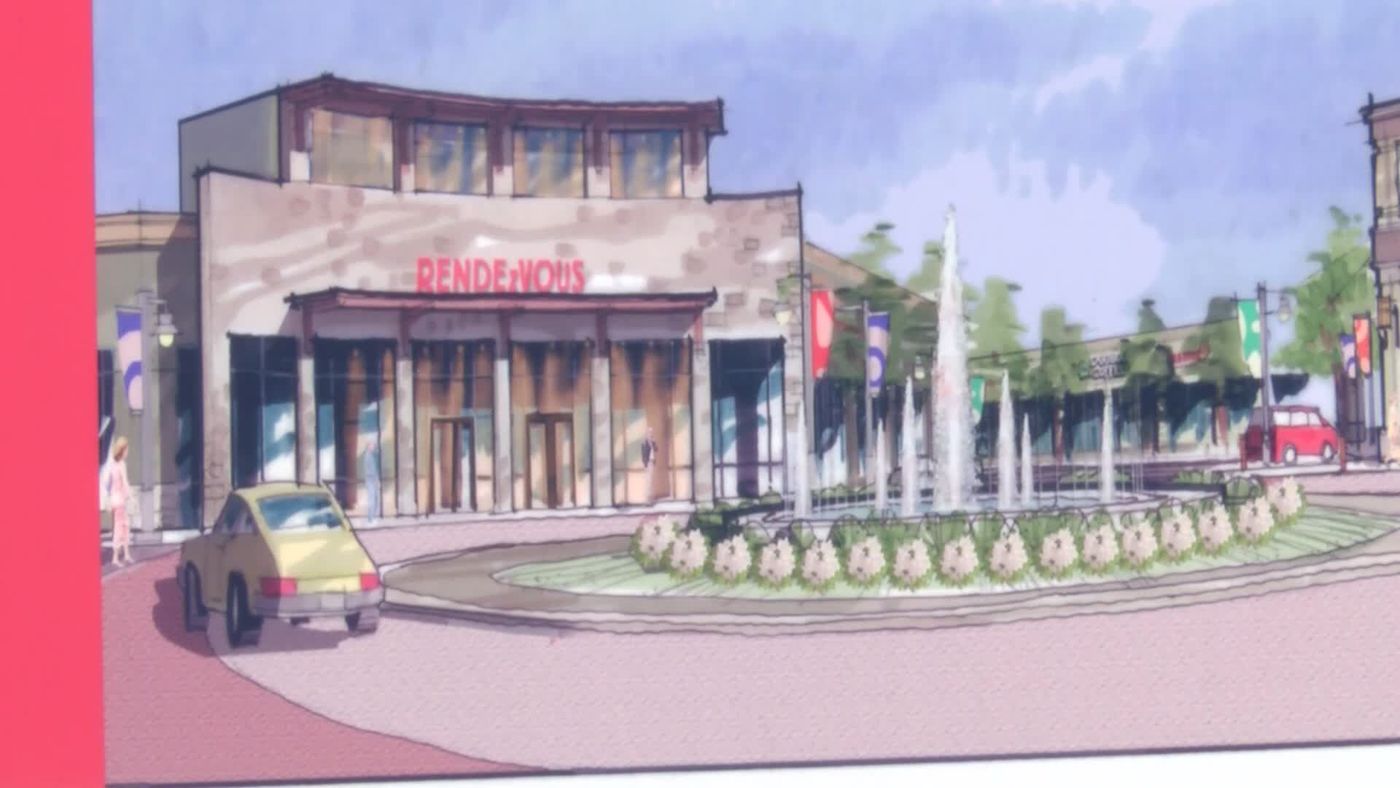
Renderings for the project presented to city officials and also displayed online at the developer's website. A drone video of the construction can also be found at that link.

I love how the store names on these renderings are so blatantly fake. Image courtesy Poag LLC

The landscaping isn't quite as lush, but other than that, the final product turned out remarkably similar. Image courtesy Poag LLC

At the time, the mall was described as "an upscale, destination-style shopping center that will include 70 stores occupying approximately 310,000 square feet of retail space. The total development also has plans to include a hotel and three restaurants on the 54 acres of land at the northeast corner of Church Road and I-55." The mall was also "identified...in a corporate news release as 'Tanger Outlets Memphis.'"

Happy as they were about the progress of the development, Southaven residents came down hard on the Memphis moniker. "People in Southaven are dead-set against having the name 'Memphis' attached to the new Tanger Outlets," DTT writer Bob Bakken reported the week after the announcement, "and have told the mayor as such." In turn, Mayor Musselwhite went on damage control, confirming that "Tanger Outlets Memphis" was simply a placeholder name, "done to let potential stockholders identify where the project is going to be. That was not the official name of the mall. ... I hear you (citizens) loud and clearly. Everybody's been in my ear saying you don't want the name Memphis in the mall, although they have the right to name the mall, they have that right." (I picture Mr. Musselwhite frantically trying to get this point across to a crowded boardroom of frustrated citizens who are talking over him.)

Ultimately, the project would open as Tanger Outlets Southaven, celebrating its ribbon-cutting on November 20, 2015. By this time, the blog had made its way into operation, and we covered Tanger in real-time in the months leading up to the date, including two construction posts (see here and here) by l_dawg2000, and the official store listing post which I've been trying my best to keep periodically updated ever since then.

Billboard advertising Tanger's grand opening date and location. Note how it strategically leaves out "Southaven." Even today, local marketing doesn't specifically refer to the place by its full name that often. Image courtesy WMC Action News 5

Photo from the ribbon-cutting ceremony for Tanger Outlets Southaven on November 20, 2015. The attached article notes, "The Outlets feature over 65 retailers with nods to Mississippi’s local music legacy and numerous fire pits for relaxation while shopping. Poag and Tanger’s joint venture ensures shoppers will enjoy a quality lifestyle outlet experience not found anywhere else." Note the use of the term "lifestyle outlet" - just as I said, a merger of the two concepts! Also, the "nods to Mississippi's local music legacy" are indeed an awesome element of the complex. Many photo albums from Tanger Outlets Southaven can be found on flickr, including here, here, here, and here. Image courtesy

The fact that Tanger wound up opening at all is a minor miracle, given how much else tried but failed to materialize at that same site over the years. However, the more things change, the more they stay the same. In that latter post, I referenced a proposed "Southaven Station" shopping center and interchange improvements from MDOT at I-55 and Church Road. Neither of those wound up happening. Tanger itself also promised locals - as quoted earlier - "a hotel and three restaurants" in addition to the outlet mall proper. Those plans, too, seem to have gone by the wayside. In fact, a 2016 DeSoto Times-Tribune article tersely titled "Still waiting" highlighted the locals' concern about the situation:

The Tanger Outlets mall has been a major economic bonanza for the City of Southaven but a promised part of the project remains unfulfilled — on-site restaurants or within close proximity of the $100 million mall. 
... 
The on-site restaurant subject was first broached by Stuart Davidson, a franchise owner and Chick-fil-A transient vendor at Tanger Outlets, who asked to be placed on Tuesday night's agenda. Davidson said he was speaking out on the subject more as a concerned citizen than as a vendor. 
Davidson said he was watched tour buses bringing in shoppers from around the region. 
The shoppers walk up to him and ask him or his employees if there are any more nearby restaurants close to the mall and he is obliged to inform them they are located nearly a half-mile to a mile away. ... "As a business owner, I want taxes to go to the city," Davidson said. "We need something more than popcorn, pretzels, cookies and candy." 
... 
[Southaven Mayor Darren] Musselwhite said he did not wish to be critical of Tanger, with whom the city has a "good relationship," but acknowledged that Davidson had a point. 
Musselwhite candidly reminded aldermen that Tanger promised to help bring restaurants to outparcel sites surrounding the mall. 
"We were promised restaurants in 2014," Musselwhite said during the meeting. "This is 2016 and there are no restaurants there. It's a problem that we're well aware of. It was all sold to us there would be restaurants."

Musselwhite later clarified, "We have total confidence in the developers to bring in the restaurants that we were promised. We have a good relationship with Tanger. We know the restaurants are coming," a statement simultaneously meant to keep up good relations with the developers but also place the responsibility in their hands. For his part, Poag president and CEO Josh Poag responded, "We're working to bring in some restaurants and finish out the outparcels," also adding that "the process is much more involved and convoluted than what the public might imagine."

No doubt that is true... but regardless, it's now 2019 - fast approaching the four-year anniversary of the outlet mall's grand opening - and still there are no restaurants at the site. Further, only one outparcel has been developed, a co-tenanted building housing Starbucks and AT&T - two retailers which are not at all new to the area, and indeed both have existing locations just two miles from their new shared quarters in front of Tanger.

Despite this qualm, however, the outlet mall itself seems to be performing quite well, with many tenants who are in fact new to the area (just as Shawn Massey had predicted back in 2009, with or without the aid of a crystal ball), and has indeed become the regional destination that local officials envisioned it would. As, for that matter, have Southaven Towne Center and Carriage Crossing, the brethren to Tanger Outlets Southaven's ill-fated predecessor DeSoto Pointe. As we have seen, development of a major project can take a considerable amount of time and is subject to many twists and turns, some even jeopardizing the existence of the project itself... but if and when it finally does come to fruition, its success can be amazing.

--------------------------------------------------

If any of you have any knowledge, information, or photos to share regarding any of the malls mentioned in this post, please feel free to leave a comment below or send me an email at midsouthretailblog [at] gmail [dot] com. Thanks for reading, and until next time, have fun exploring the retail world wherever you are!

Retail Retell