|
| Today's post highlights Shelby County, TN, retail. |

"McNames abound in the McDonald's vernacular," begins a 1995 Chicago Tribune article. "There aren't too many McMonikers that consumers can't identify."
By the 1990s, McDonald's, of course, was already a household name. Their iconic double-mansard roof restaurants were instantly recognizable, and dotted the nation's – nay, the world's – landscape. But iconic though they were, McDonald's still wasn't quite everywhere. Sure, maybe geographically they were – or close to it, anyway. But what about that McDonald's down the street, attached to the gas station? Or the one that used to be in your local Wal-Mart? Those McDonald's didn't exist yet; until the 1990s, McDonald's largely relied on standalone locations only.
Today's post is the story of how that changed.
--------------------------------------------------
Before we get going, I owe a big "McThanks" to my flickr comrade Coolcat4333 (who is also proprietor of the blog East Coast Retail) for the inspiration for this post. Coolcat recently posted several images of a strange-looking McDonald's bearing the name "McDonald's Express," along with some information on how that location is so tiny it doesn't even serve certain mainstay menu items such as Quarter Pounders and iced coffees. Naturally, I was intrigued, and decided to research a little further to see what I could find about this mysterious operating concept. Lo and behold, one of the first hits Google brought me was an October 1991 Los Angeles Times article entitled "Here's Your Hamburger, What's Your Hurry?":
The McDonald's restaurant taking shape near the Navy Exchange building at the 32nd Street Naval Station in San Diego will feature the fast-food chain's fabled golden arches, Chicken McNuggets, assorted burgers and french fries.
But, unlike other McDonald's, this small, prefabricated metal building will have no indoor seating.
Instead, patrons will be served at a drive-through and two walk-up windows--and they'll select their meals from a decidedly slimmed-down menu that won't include milkshakes, Quarter Pounders or a handful of other items sold at the thousands of McDonald's elsewhere in the country.
The 630-square-foot McDonald's Express, which was trucked in from Los Angeles on Monday, is a prototype of others that might be built elsewhere ... The prefabricated buildings are designed for locations where most customers are buying food for off-site consumption.
All of this was already golden – I knew I'd stumbled upon a subject for a new Lost History post – but the next paragraph was what excited me the most:
The building, which measures 14 feet by 45 feet, will become the seventh McDonald's Express in the country when it opens in early November. The others are in Akron, Ohio; Baton Rouge, La.; Atlanta and Memphis.
Yep, you read that correctly – Memphis was home to one of the very first McDonald's Express restaurants! So not only did McDonald's Express present me with a short-lived concept worth shining light on, it also had a local connection to the Mid-South, too. Could things get any better?! Well... what if I told you the Memphis McDonald's Express was still operating? :)
Obviously, we'll explore that later on in this post, but first, I want to continue spending some time on the history of this concept and how it, and the thinking it fostered within McDonald's corporate, resulted in a slew of other, longer-lasting/wider-reaching concepts that had ramifications not just for the golden arches but for the industry as a whole.
 |
| McDonald's Express logo sign. Courtesy eBay |
My research next took me to the Commercial Appeal archives, to try and dig up information on Memphis's McDonald's Express specifically. Readers don't have free access to any full articles from the archives, but the search option does give you the first several paragraphs of any given article's text. Sure enough, I found this story from July 31, 1991:
Fast Food - McDonald's Planning Express Site
McDonald's is erecting a modular drive-through, walk-up restaurant called McDonald's Express at Perkins and Quince to try to win back customers.
It is McDonald's first double drive-through in Tennessee. It is to open by September. The unit, which will be less than 900 square feet, will feature a limited menu.
It will have a few picnic tables in front of the store for folks who walk up to place orders and two drive-through bays for car-bound customers.
A November follow-up article further explained McDonald's reasoning for introducing McDonald's Express to the Memphis market:
McDonald's Joins Faster Fast-Food Race
You could call it a Little Mac, but McDonald's Corp. calls it McDonald's Express.
And the new drive-through-only restaurant is part of the fast-food giant's strategy for recapturing market share lost to others in the fast-growing niche.
The McDonald's Express at Perkins and Quince, the first in Tennessee for the company, opened in September, joining Back Yard Burger, Central Park, Rally's Hamburgers and soon-to-open Checkers in the double-drive-through business locally.
In other words, in Memphis the primary purpose of McDonald's Express was to try and compete with a horde of double-drive-thru newcomers whose new operating style was stealing business from existing McDonald's locations. Originating in the 1980s, the double-drive-thru concept allowed these chains to find success from lower start-up costs and lower operational costs due to the smaller size of the buildings and their prefabricated nature, savings which were then passed on to consumers with prices so low – "about 30 percent below that of the major chains" – that they began to make the "traditional" fast food joints look expensive.
This model was evidently very popular in the Mid-South; as noted in the above excerpt, Checkers (like McDonald's Express) joined the already-crowded area scene in 1991, and by 1994 ceded its seven local locations to competitor Rally's – who had ten locations locally – as part of a larger swap between the two chains involving seven total cities that was poised to "eliminate competition between the firms in various markets." (The two would wind up merging together into a singular entity just a few years later, in 1999.) McDonald's, it seems, opted to take the "if you can't beat 'em, join 'em" approach in making their decision to enter the fray.
 |
| It would seem later double-drive-thru/walk-up McDonald's locations were branded as "Mini Mac" instead of McDonald's Express. Image source unknown |
But while in Memphis the McDonald's Express concept may simply have been to up their game against the other double-drive-thru burger chains, elsewhere in the country the goal of McDonald's Express was to interject McDonald's into every facet of consumers' lives: per the book Food Justice, "an overall 'convenience strategy' designed, as McDonald's put it, to 'have a site wherever people live, work, shop, play, and gather' in order to 'intercept them at every turn.'"
So, you know, just regular old casual world domination... but it worked.
--------------------------------------------------
McDonald's quickly expanded its Express concept to Manhattan, introducing in 1994 "plans to blitz New York with its smaller Express restaurants to increase its presence." Entering these so-called secondary markets (secondary, that is, to areas where its full-size restaurants already operated), McDonald's claimed, would allow it to "fill in the seams of our operations" and gain better exposure in order to place the product closer to the consumer – a philosophy that, experts said, would result in increased sales. Not all McDonald's Express outlets were double-drive-thrus – clearly, this would be next to impossible in Manhattan! – but instead varied in format depending on the location, with some indeed featuring indoor seating, albeit limited in number compared to full-size restaurants. The main takeaway, the Manhattan McDonald's Express franchisee said, was that McDonald's Express allowed McDonald's "smaller square footage and more lease flexibility," which in turn generated higher returns for both the operator and the corporation.
The one constant of all McDonald's Express locations was the limited menu, mainly due to the space limitations. "Milkshakes won't be served, for example, because there's no room for the shake machines. And Quarter Pounders will have to go because there isn't enough room for the storage and preparation of the McDonald's mainstay," reads the 1991 LA Times article I referenced earlier. "Neither is there room for the machines that generate frozen yogurt and ice cream products. Instead, the Express will offer 'novelty ice cream products like Dove or Snickers bars.'" But initial concerns about customers' reactions to these menu exclusions, franchisees relayed, were surprisingly waved away. "People don't seem to mind. I've heard of no complaints about the menu. The customers already know that there is something different because of the different signage."
 |
| Stock photo of a McDonald's Express in Harlem. Courtesy Alamy |
 |
| Perhaps the infamous 1990s "lightning script" logo originated from the McDonald's Express concept? Compare the "Express" swoosh in this image to the one featured on the awning in the above image. Courtesy Yelp |
Buoyed by seeming success, McDonald's Express continued expanding nationwide, "setting up shop anywhere and everywhere there is sufficient traffic." This policy allowed the chain to "squeeze into locations not ordinarily associated with fast food restaurants," including mall food courts, military bases, airports, hospitals, schools, office buildings, sports arenas – you name it. In 1998, there was even an effort to turn an abandoned bathroom in a Bronx park into a McDonald's Express. (That deal fell through, but the space did eventually become home to a Wendy's.)
From there, McDonald's sights only broadened. In the decade prior, McDonald's had experimented with both larger- and smaller-scale concepts, including the McStop ("a 30-acre site that will house not only one of its restaurants, but also a motel, gas station and convenience store") and the McSnack (an extremely tiny format designed for high-foot-traffic areas that was so small it didn't even serve hamburgers or fries). But with McDonald's Express, the company seemed to have found its sweet spot in size, and as such felt increasingly emboldened to introduce McDonald's Express outlets into even more nontraditional sites. Notably, in 1993 it was announced that "Wal-Mart Stores Inc. is test-marketing scaled-down versions of McDonald's restaurants in its stores in Fresno and Visalia, Calif." – a partnership that soon grew into McDonald's becoming, for a time, "the exclusive in-store restaurateur for Wal-Mart," with over 1,000 in-store units in the US and locations in every Wal-Mart store in Canada. McDonald's also opened multiple in-store units in several Home Depots, Meijers, and other retail chains.
 |
| Example of an older McDonald's inside Wal-Mart. Image source unknown |
 |
| "McDonald's in Wal-Mart" logo pin, dated 1994. McDonald's was in over 100 Wal-Marts by August 1995, and over 800 by November 1996. Courtesy eBay |
Likewise, McDonald's quickly jumped onto the gas station bandwagon, seeing dollar signs in the idea of pairing a McDonald's Express with a fueling center in order to create a one-stop shop. By late 1995, McDonald's had struck deals with an A-list of gas station/C-store operators – Chevron, Mobil, BP, Texaco, Shell, and finally Amoco – for regional alliances that would result in co-branded retail operations that, ideally, would increase profits for both parties. Projections estimated that McDonald's and its two largest partners, Amoco and Chevron, would develop about 300 fuel center/McDonald's Express combos a year.

 |
| Images of two "McDonald's Oil Alliance" locations, the Chevron in Dalhart, Texas, and the Amoco in Chicago, Illinois. Note how the architecture for both is virtually identical. Courtesy Kendrick Development |
 |
| Pins featuring the "McDonald's Express & Amoco" branding and the "McDonald's & Chevron" branding, respectively. I may or may not own these now :) Courtesy eBay |
To be sure, McDonald's wasn't necessarily the first to experiment with opening scaled-down restaurants in all of these nontraditional venues. In fact, McDonald's was reportedly driven by Taco Bell, owned in the 1990s by PepsiCo and which "led the way by selling its Mexican food from kiosks in shopping malls, tiny outlets in convenience stores and in school lunch programs." Years before McDonald's partnership with Amoco, Burger King teamed up with the gas station brand in 1991 to open what was hailed as "the first operation where motorists can pump gas while ordering food," and Wendy's led the pack before anybody by opening one of its restaurants inside a Kmart in 1985.
But, arguably, McDonald's was the one to take all of these experiments farther than the rest, and make the partnerships feel mainstream. After all, these days it's not unusual in the slightest to see a travel center featuring a gas station paired with well-known national fast food brands, or an in-store restaurant such as Subway inside Walmart or Starbucks inside, well, everything. But in the 90s, these concepts were entirely new to consumers – and McDonald's paved the way in making them commonplace, all evolving from its McDonald's Express concept. I guess you could say that McDonald's Express led to a new way of McLife.
--------------------------------------------------
Despite the optimism and high expectations concerning the growth and expansion of McDonald's Express, soon the glow began to wear off. Initially, McDonald's Express units were offered only "to franchisees of successful traditional units." In turn, "each Express restaurant becomes a satellite of an existing McDonald's under the same franchisee. Storage space, lacking in the smaller outlets, is provided at the full-size restaurant."
But as corporate pushed the concept further, they became more involved in its implementation, effectively pushing the franchisees aside – and worse, eating into their business. "Consider franchisee Wayne Kilburn," reads a November 1996 Forbes profile:
In 1980 he and his wife, Mary Jane, took over the sole McDonald's in Ridgecrest, Calif., a high-desert town of 26,000 about an hour west of Death Valley. Kilburn turned the restaurant into a huge profit machine. Then McDonald's came up with a market share plan for Ridgecrest. In September 1995 it put a company-owned restaurant inside the new Wal-Mart in town. Late last year McDonald's built another outlet inside the China Lake Naval Weapons Center. A third new company-owned store went up right outside the naval base.
"Basically, they killed me," says Kilburn. He claims his volume has dropped by 30%. Kilburn, who doubts that...his volume [will be restored] to its prior peaks, wants out and is now negotiating to sell his franchise back to the corporation. The two parties will probably end up reaching a deal.
A February 1997 article from Crain's Chicago Business – titled "McD-Amoco Venture is Low on Gas" – echoes the above sentiment, writing, "The loudest gripes are coming from McDonald's franchisees and Amoco and Chevron station operators who are in business near combination sites. They complain about sales cannibalization, saying the higher traffic at the combo stores eats sales from stand-alone restaurants or gas stations that are sometimes only blocks away."
Accordingly, McDonald's and its oil alliance partners began "putting the brakes on [their] ambitious plans to fuse fast food with fast gas." Originally projected to have "2,000 such restaurant/gas station combinations by 2000," at the time of publication in 1997 "only 117 combination stores are open (67 of them Amoco/McDonald's sites) and a handful have been or will be closed." In addition to the franchisee cannibalization complications and industry observer claims that "the satellite restaurants in combination C-store/gas stations are posting mixed results and risk diluting the powerful McDonald's brand," according to Crain's, "Corporate identities were at stake, too":
At the time the deals were inked, McDonald's Chairman and CEO Michael Quinlan lauded the concept as a "key driver of growth." What he didn't count on, however, are logistics and egos ... Much time and effort was spent debating whose sign should go on top.
"We're both very protective of our brands," explains Amoco's Edward Hoffman. "They have very strong opinions on how they want to present their brand, and so do we... It hasn't been an easy process."
Most signs at the sites now sit side-by-side. Maintenance costs are shared, but McDonald's -- with more stringent rules on cleanliness because it handles uncooked food -- usually takes control.
Coffee and dispensed-soda sales at the linked gas stations -- a traffic generator for Amoco and Chevron -- are not allowed when the McDonald's side is open. Cigarettes and beer are not sold near the McDonald's side of the complex, nor are they prominently displayed.
 |
| Another example of a co-branded Amoco/McDonald's location. Looks like the McDonald's sign won out in the battle for whose sign should go on top at this one! Image source unknown |
Eventually, the McDonald's Express branding faded away, making it a perfect Lost History subject for today's world. While McDonald's located in gas stations are still common nowadays, I'm not certain they have exclusive partnerships like they did with Chevron or Amoco any longer (and Amoco, of course, merged with BP in 1998, then proceeded to disappear as a brand for over a decade beginning in 2004). Assuming any Wal-Mart in-store McDonald's locations bore the "Express" designation in the first place, that tagline was likely simply dropped at some point along the way (regardless of whether or not the menu was full-sized or limited), similar to how the Walmart of today makes no distinction between its normal stores and its Supercenters. In fact, many Wal-Mart McDonald's have since closed, as have a very large number of individual McDonald's Express locations around the country. Crain's suggests this trend away from McDonald's Express began as early as 1997, a mere six years after the concept was first introduced:
A "mini-McDonald's" offering limited menu items did not work. Many of those sites have been shuttered, including one in south suburban New Lenox (part of a broader shutdown of more than 100 kiosks and other smaller venues announced last month).
"Customers want the full McDonald's experience," says a McDonald's spokeswoman.
Long-term survival of the brand or not, McDonald's Express is emblematic of the corporation's attitude of experimentation in the final decades of the twentieth century. Even more obscure than these "small fry" McDonald's concepts I've been discussing are short-lived full-blown diner-style restaurants that were tested in various cities, including Hearth Express, Golden Arch Café, and the McDiner. On the other end of the spectrum, consumers likely remember plenty of new menu items McDonald's toyed with in the 80s and 90s, including the Arch Deluxe, the McDLT, the McLean Deluxe, burritos and fajitas, and of course, the McPizza. That early McDonald's Express at the naval base in San Diego was even poised to serve hot dogs and chili, in another departure from the norm for the already-radical new concept.
 |
| The McPizza. Enough said. Courtesy MentalFloss |
For what it's worth, this era was also when McDonald's began to increasingly convert and occupy "unusual existing buildings," such as a former savings and loan building in Minnesota and a railroad caboose in New York. A lot of those locations – as well as other locations with otherwise normal exteriors, but uniquely-themed interiors – are endangered these days, as McDonald's pushes its franchisees to remodel all locations to a much blander design. Perhaps at least part of the reasoning behind this is that McDonald's doesn't feel it needs to experiment or be unique anymore; they've finally achieved that status discussed earlier where they are, in fact, intercepting consumers at every turn. Likewise, the persistent menu additions seem to have largely disappeared; by now, everyone knows what McDonald's is, what it serves, where to find it, and what to expect – is this complacency? I'll leave that up to you all to decide. For now, though, I'll link you to two flickr photostreams: those of RetailRyan and The Caldor Rainbow, who have been traveling to and documenting various unique McDonald's locations before they are inevitably remodeled beyond recognition.
As a final note before we move on to the next portion of this post, I wanted to briefly reference an article I came across in my research, published just last month in the UK:
McDonald's is launching new mini outlets with a reduced menu so it can serve meals faster.
The first has opened on Fleet Street in London, and the focus on takeaways means there is no in-store seating.
All customers in the so-called "McDonald’s to Go" stores must order via a touchscreen.
A more limited menu of favourites such as Big Macs, McNuggets and Big Flavour Wraps will mean staff can have more of them ready at peak times.
McDonald’s is trialling the new format ahead of rolling it out to other town and city centres where there is likely to be demand.
Sound familiar? The more things change... :)
--------------------------------------------------
So finally, after that lengthy written Lost History component, we arrive at the titular focus of this post: the still-operating, original McDonald's Express in Memphis. Located at 4657 Quince Road, it would stand to reason that this restaurant has been operational since 1991, the year it opened as part of the first group of seven McDonald's Express stores. I visited the restaurant just shy of a month ago, on August 30, 2019. My photos follow.


We begin with a handful of shots taken while driving past on the roadway, as we approached the restaurant. Given the size and layout of the lot, I had already anticipated that getting on-property photos of the front of the building would be a challenge. Unfortunately for us, the front of the building is, as ever, a majorly-important part, so I hope you'll forgive any objects that impede its visibility in my images.


Some closer shots of the front of the restaurant reveal that, aside from it being miniaturized and having a walk-up window instead of a front door, the facade looks amazingly similar to your regular mansard roof McDonald's of that era. This in turn sadly means that there is no actual "Express" branding on the building itself, but in all honesty even the mansard alone is becoming rare these days, so I won't complain about seeing it still intact here.


At the corner of the property – located at the intersection of Quince and S Perkins – stands the tall roadside sign, bearing the golden arches. But look closely – that's actually McDonald's Express branding on there! It was very exciting to be able to see this in person, with the knowledge that this is actually a remnant of a widespread past concept as opposed to just a strange one-off sign.


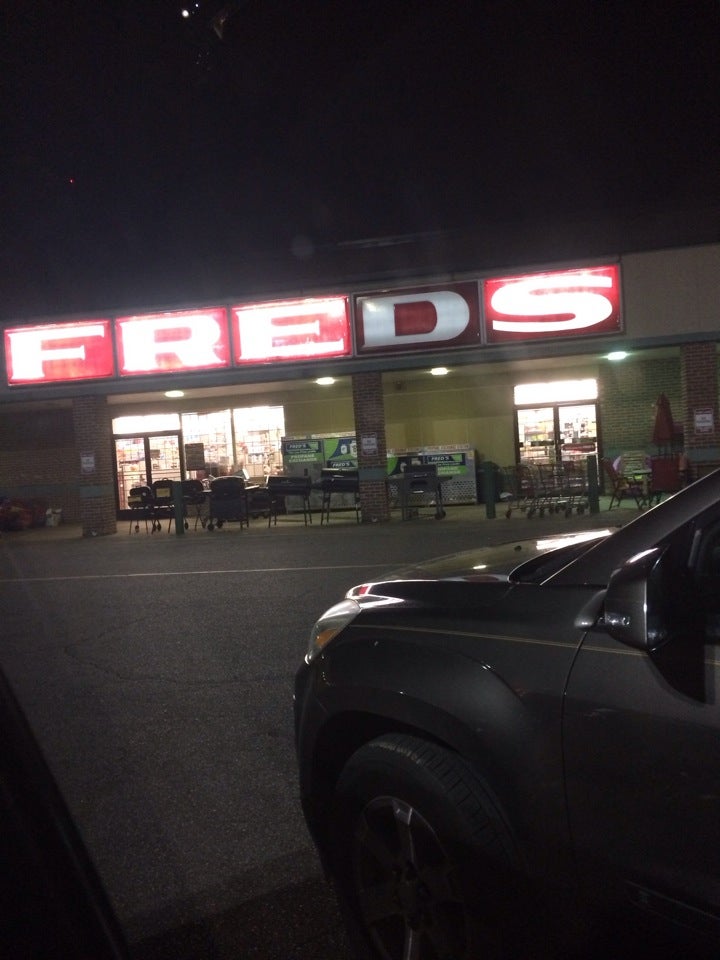
Because I wanted to get those drive-by pics of the property, we had to circle back around a bit before entering the lot, which resulted in me getting these two pics of nearby retail sights as well. On top is a shot of the shopping center located directly behind the McDonald's Express, featuring a Superlo Foods and a now-shuttered Fred's (the final Fred's in Memphis to retain vintage signage similar to what we saw at the Munford franchise location). Below that is a pic of the also now-shuttered Rite Aid located directly across the street from the McDonald's Express. It crossed my mind that, if the franchisee were interested, he or she could probably purchase the Rite Aid property, tear down the building, and construct a brand-new, full-size McDonald's on the lot, replacing the existing Express location. Hopefully, of course, that doesn't happen, but with the possibility out there I'm even more glad I visited when I did!
(And yes, speaking of Fred's... I'm sure you're all expecting a post from me on their recently-announced bankruptcy and decision to wind down operations. Your wish will be granted next month...)

Entering the property, since my main goal was to explore the place and take some pictures for y'all, naturally we parked instead of going through one of the drive-thru lanes. The parking lot is fairly small – although it does have a larger footprint than the building itself! – and is located off to the right side of the restaurant. This can be better seen in the aerial view of the property. Google Maps also provides some pretty good Street View coverage of this place, including historical imagery showing that the building retained the classic white and red paint scheme until circa 2017.

Nowadays, the building is beige in color, as seen behind this vintage McDonald's logo affixed to the building's right side wall (facing the parking lot). But that seems to have been the only change on the property in recent years, with everything up to and including the Express road sign and the mini-mansard roof left alone, so let's hope things stay that way!


To emulate the view as one travels down the drive-thru lane along this side of the building, I took these shots of the menu board and the patio forming the border between the building/drive-thrus and the parking lot. I didn't walk over to the other side for a similar view of the second drive-thru lane, so I've pulled an image of that from Google and included it below.
 |
| Courtesy Google Maps |

Per that Google user image of the other drive-thru lane, it would appear only this parking lot-facing side of the building has one of these vintage structure-affixed McDonald's logos. These always look a lot older than they really are (at least, in my opinion). Still, though, it's great to see this one still here. I just wish those shrubs in front of it weren't blocking it so much!

We ordered from the walk-up window, and while there I snapped this shot of the menu available for customers to browse and select from. For one thing, you can compare the presentation of this menu to the one shown on the considerably larger drive-thru board earlier in this post; but for another, you can see from either menu pic that, contrary to what I told y'all of McDonald's Express's origins, this restaurant does not appear to be serving a limited menu – note the presence of Quarter Pounders and shakes, among other things. Evidently, the restaurant's capabilities over the years have been increased, which of course is beneficial.
A fun fact I uncovered in my research is the discovery by a handful of folks that remaining McDonald's Express units, for several years past the "official" replacement of fried pies with baked pies on the menu, continued to serve fried pies, because the Express outlets did not have ovens in which to bake the pies in accordance with the new recipe. The menu at the Memphis McDonald's Express did indeed have pies on it, but alas, I wasn't hungry enough when we visited to order one (all I got was some fries). But several of those reports had been updated more recently to say the Express stores, too, finally switched over to the baked recipe, so I don't think I was missing anything.
 |
| Courtesy Google Maps |
 |
| Courtesy Google Maps |
These next two images again come to us courtesy of Google user contributions. I chose to include them because they show things I wasn't able to capture on my visit. Up top is a shot of the McDonald's storefront sign lit up at night, which I thought looked neat. And below that is a quick peek inside the restaurant from one of the service windows. I got a quick peek in through the walk-up window, of course, but I didn't feel comfortable taking a photo through it. In any case, whether or not it's clearly visible in the photo, you can imagine that the interior of a McDonald's Express unit is considerably more compact in layout than a regular McDonald's Kitchen.


Probably my favorite two shots of the whole post, right here :) Up first is as good of a wide view as I could get of the entire restaurant, and below that is a close-up of the iconic mansard roof with its yellow french fry lights and the McDonald's logotype. Again, it may not say "Express" directly on the building, but this is still cool in its own right, especially as more and more of these similar rooflines disappear!


The front of the property featured the traditional arrow-pointing "enter" and "exit" signs, as well as this more unique "Thank You" sign posted at the end of the left-side drive-thru lane. In hindsight, I should've gotten a closer shot of at least one of the enter/exit signs as well, but it is what it is. Who knows, maybe I'll be back again someday to remedy that :)


Here's the view from the "front porch" of the restaurant, as it were, over toward the roadside McDonald's Express sign at the corner of the property, followed by a closer shot of said sign. Note that the "Express" logo used here is different from the one seen in other applications earlier in this post, with sentence case letters and dashes running through the letters themselves (as opposed to running along the left side of the letters). Personally, I think I like this one better.


Some more close-ups of the McDonald's Express sign (actually just crops of previous images, but don't tell my readers that!). Unfortunately one side of the sign's face has been slightly damaged – but thankfully not so badly as to necessitate replacement (knock on wood!)...


Returning to our car, I snapped some full-building views along the way, which I think capture the layout of the property pretty nicely. I also discovered that I inadvertently captured an employee delivering a meal to a customer waiting in a parking space (you can even see them driving away, in the last pic!) – so apparently even this McDonald's Express features curbside delivery, just like all the full-size locations! Pretty neat...


These three successive pics show the scene as we drove away. They're kinda repetitive in nature, but I included all three of them anyway. Something I was curious about was the umbrellas over the patio tables... to me, those look like they could be fairly recent (for some reason the yellow/teal color scheme gives me this impression), but Street View shows them here as far back as the imagery goes (2007), and it's quite possible they had been here for years before that, too, perhaps even back to this restaurant's 1991 opening. Wish there was a way to find out for sure...

I tried to get a good shot of the front of the building as we drove past, but that's kinda hard to do from a car window with sun glare also interfering! Oh well, at least it turned out much better than it would have with my old phone (oh yeah – forgot to mention, I have a new phone now! I think these are the first photos from it that you're seeing on the blog; more will come in the future, of course).
One final interesting thing I wanted to note is the setup of the parking lot-facing drive-thru lane here. As you can see, the pick-up window is located at the front of the building, but the menu board where you place your order is located at the rear (as we saw earlier). That means that when customers use the drive-thru on this side, they have to reach all the way over from their driver's seat, across the passenger seat, in order to reach the window. Who on earth thought that was a good idea?!


Retail Retell
UPDATE, April 2021: As suspected, McDonald's has indeed purchased the former Rite Aid building across the street from the Quince Road McDonald's Express, and has constructed a brand-new full-size location that will replace the existing restaurant once it opens. See the photo below for a look at the new building. You can also see more details on the site plan and architecture in this PDF.
 |
| New McDonald's, as viewed from the existing McDonald's Express lot, 4-13-21. Courtesy Google Maps |