Saturday, October 21, 2023

Spend a Little, Spend a Lot (2023 Edition)

Today's post highlights the effects of inflation on the US economy in the past decade and a half. Fun!
 
I went back home for a weekend recently, and as I'm sure is a common occurrence for many, came away with some old odds and ends my mom found while cleaning and reorganizing that had been tucked away in some closet somewhere. Sentimental at heart (note that there is a fine line between "sentimental" and "hoarder") and always reluctant to throw things away, naturally I brought the items back with me to my apartment. Not that I had seen any of them in quite some time, but one of the items in particular was one that hadn't crossed my mind in years: my old second grade science project. This was not the tri-fold cardboard display exhibited at the science fair -- only the little booklet that went with it -- but still, it brought back a lot of memories.

Young Retail Retell, it turns out, was just as much of a nerd as his older, more tired counterpart. Long before he ever dreamed or even heard of starting a flickr page or running a blog on which to share supermarket photographs, history, and research, as an eight-year-old he dragged his parents to three different grocery stores on three consecutive Fridays to compare prices and see which store was cheapest. Even back then, I was fascinated by brands, logos, and stores: no one can say I'm not consistent! The project, titled "Spend a Little, Spend a Lot," was the result. Check it out below:


We start with the page summarizing the entire project from start to finish. To summarize the summary, the gist of the project was to see which local grocery chain -- Walmart (which, you'll notice, I stylized even in my own handwriting with the star logo; that's dedication right there), Kroger, or Schnucks (RIP) -- had the lowest prices over that three-week period in January 2006 (a mere 17 years ago...). I anticipated Walmart would come out on top, and while the sale prices at the other two sometimes did win out, Walmart was cheapest overall.


Backing up my summary was the actual data page, showing the comparison by item, store, and date (with sale prices in parentheses next to the regular prices at Kroger and Schnucks). I compared 10 items at each store, many of which (as you might can imagine) were influenced by some of my favorite groceries:
  1. Nature's Own 100% Whole Wheat Bread
  2. Kraft Deluxe Sharp Macaroni & Cheese (14 oz) -- sadly, this one disappeared from Walmart and Kroger shelves more than a decade ago...
  3. Welch's Concord Grape Jelly
  4. Oscar Mayer Beef Bologna (8 oz)
  5. Minute Maid Premium Orange Juice (1 gal) -- surprised I went with the regular; even today I unashamedly buy the "kids" variety
  6. Diet Coke 12-pack cans
  7. Doritos Spicy Nacho Chips (13 oz) -- spicy >>> regular
  8. Campbell Condensed Vegetable Alphabet Soup (10 oz)
  9. General Mills Cookie Crisp Cereal (12.25 oz)
  10. Del Monte Fresh Cut Green Beans (14.5 oz) -- I did always like my vegetables


The total weekly average is shown at the bottom of the data page, and presented in visual format on this nifty little Microsoft Excel graph page, too (ah, the wonders of modern technology!). You can see Walmart was the lowest at $22.56. Kroger, inclusive of its sale prices, came in $3.03 higher, at $25.59. For its part, Schnucks averaged $26.53 with sale prices, but at regular prices, Kroger and Schnucks were only pennies apart (albeit both nearly $7 more than Walmart's "everyday low prices").

For fun... and because I'm a weirdo who actually considers such a thing to be "fun"... I decided it would be neat to reperform this experiment in 2023, and see how the prices compare now to back then. Would the results remain similar? Is Walmart still the cheapest? How much have prices gone up?

To make the process simpler (and because I sure as heck am not going to spend as much time on this part of the ordeal, even though one could argue this blog post in total is more time than I spent on the entire original project...), I opted to take the "quick and dirty" route for my 2023 price comparison. First of all, Schnucks left the Mid-South in 2011, so there's one competitor down. For Walmart and Kroger, I simply opened up their apps on my phone (on Monday, October 16, 2023) and looked up the prices that way. Some items, it should be noted, aren't available locally here in Ridgeland and/or anymore at Walmart or Kroger, so I've selected the next closest substitute as necessary. (It would also be an interesting commentary to analyze how product sizes have changed, but that's beyond the scope of this particular exercise.) Finally, on the Kroger side of things, I've collected only sale prices -- not bothering with regular prices this time around. Below, my results:
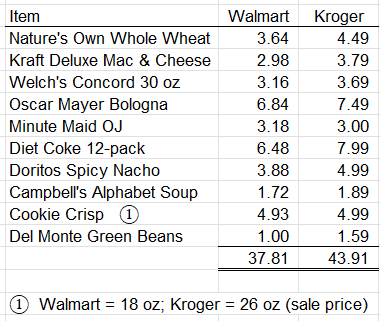

As you can see, Kroger in some instances still has sale prices better than Walmart (notably the Cookie Crisp, which -- because the two stores now sell different-sized packages -- nets you 8 more ounces for only 6 more cents), but Kroger still loses overall with a total price of $43.91 as compared to Walmart's $37.81 (a difference of $6.10).

What do these results tell us? Read on to find out...

--------------------------------------------------

As a student who never particularly enjoyed his science classes, it pains me to come to this realization, but a science fair project isn't all that different, fundamentally speaking, from an audit. For those of you who weren't already aware from past information I've shared about my life on flickr and my blog, these days I am a licensed CPA working as an independent external auditor. In a science experiment, you derive a hypothesis and then perform certain tests to confirm whether or not the evidence that you collect actually supports that hypothesis as being true, or outs it as being false. In an audit, the company we are auditing is making representations about its financial standing at a specific point in time and its financial performance over a specific period of time (leading up to that specific point). As auditors, we come in and gather evidence to determine, within a degree of reasonable (but not absolute!) certainty, whether or not management's assertions appear correct. In a science experiment, the end result is a conclusion on what the procedures performed reveal about the initial hypothesis. In my line of work, the deliverable is our evidence-based independent auditors' opinion on the company's financial statements. In principle (if not in practice), not too dissimilar, all things considered.

Looking closer, an analytical procedure holds even more of a resemblance to a science fair project. Analytical procedures are one specific type of test that auditors use, and really don't provide actually much concrete evidence at all; they are not considered to be a substantive test, which involves obtaining actual physical evidence to support the numbers (or whatever other assertion[s]) we're looking at. Instead, the main evidence that analytical procedures provide is simply an assessment of reasonableness, basically as if it's a smell test... does the actual outcome that we're seeing look more or less like it is correct, given what we'd estimate the same outcome to be based on past knowledge (which we still expect to hold true) and current trends (whose impact on our past knowledge we can appropriately account for)? Or, does the actual outcome smell a little fishy, as if there are some other factors impacting it that warrant some further digging? Recognizing that reliance on analytical procedures alone does not provide the same form of obvious substantial audit evidence as other, more involved tests, they nonetheless can give us comfort over something that feels like it looks reasonably okay, or point us in the direction of something that may need a little more attention.

So. If the analytical procedure is intended to test for reasonableness, then "precision" is the metric that we use to define what we consider to be within the realm of reason. Precision is typically expressed as a dollar amount, and most commonly as some form of materiality. "Materiality" is what auditors use to judge what matters. What matters to me -- in many senses, not just monetarily! -- might not matter to you. Likewise, as an explicit monetary illustration, $500 might not matter much at all to some big insurance conglomerate, but it might matter a heck of a lot to that small nonprofit organization down the street. In an analytical procedure we are looking to see if the actual results that we encounter make sense in comparison to the expected results that we calculate, and look to explain any difference, or "variance," between the two. If the variance is small enough to be below our stated precision -- that is, deemed "immaterial" -- we accept the results as "within expectation," and move on with our lives. Any variances that are outside of auditor expectation invite further investigation.

Let's all put our auditor hats on, on top of our second grade science fair beanies we're already wearing (all complete with little propellors, of course!), for this next bit. We know what the results of my experiment were in 2006. We also know what the results are for 2023. Going to our trusty friend Mr. Internet, we can obtain independent external evidence on what effects inflation has had on the US economy as a whole over those 17 years. Using that information, we can derive an auditor's expectation -- form a hypothesis -- of what we think the Walmart and Kroger prices should be. And finally, when we perform our test to compare those "should be" prices to the prices that actually are, we can evaluate and conclude on whether the difference is immaterial (the increase is due exclusively to inflation) or whether there are other factors at play (Walmart and Kroger have raised their prices beyond the normal inflation amounts).

Not the type of blog post you expected to jump into, is it?

--------------------------------------------------

Since they've been proven twice over to be the cheapest, with all others looked at in comparison to their baseline prices, we'll continue to use Walmart as the basis for our analysis, as the certified Low Price Leader™. (Actually, that tagline belonged to Fred's, but they don't exist anymore. Their auditors were right to give them a going concern opinion in 2018.) For materiality purposes, since this procedure is relying highly on small dollars and cents, let's say anything more than $1.00 will be outside of our expectation.

We'll begin by gathering some evidence on inflation. According to the website Carbon Collective, the total inflation rate between 2006 and 2023 is 49.23%. This is calculated by taking the difference between the Consumer Price Index (CPI) in 2023, which is 300.84, and in 2006, which was 201.6, and converting to a percentage, as follows:



From this, we can reasonably say that, all else held equal, we would expect Walmart's prices to have gone up by approximately 49 percent due to inflation. Any increase much more than that amount would suggest that consumers are paying comparatively more than they did in 2006 for the same (or similar) items. Let's see:


An inflation-related increase of 49% on Walmart's 2006 prices would lead us to expect that the 2023 prices should be around $33.67. However, the actual prices we are witnessing total $4.14 greater than that, which exceeds the $1.00 wiggle room we set for ourselves. Therefore, of Walmart's total 2006-to-2023 price increase of $15.25, approximately 27 percent is due to factors other than inflation.

We could analyze Kroger in the same way, but at the Kroger level there are not one but two factors at play. First is the basic inflation factor, like we just saw with Walmart. But second is the competition factor: that is, has Kroger maintained the same ratio of cost competitiveness with Walmart that it had back in 2006? Has it narrowed the margin and gotten closer to Walmart's prices? Or has it become even more expensive than Walmart than it was 17 years ago? Let's take a look.
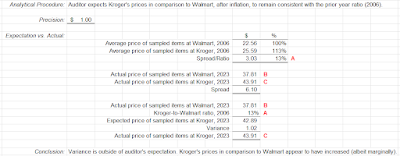

As it turns out, Kroger is basically just as competitive with Walmart as it was 17 years ago. In the analysis above, we determined that Kroger's prices were approximately 13 percent greater than Walmart's back in 2006. We would expect that ratio to remain consistent, even after inflation. So, taking Walmart's present-day 2023 prices and increasing those by 13 percent allegedly should get us somewhere close to Kroger's present-day 2023 prices. Indeed, we find that Kroger's 2023 prices of $43.91 are a mere $1.02 greater than our calculated expectation of $42.89. Technically, that is two cents outside of our precision, and it really depends on how you look at it: percentage-wise, it's a 16 percent ratio as opposed to 13 percent, which is a 23 percent increase (3 percent change divided by the original 13 percent ratio). But ultimately, regardless of the percentages, $1.02 really doesn't make a whole lot of difference to my wallet (your results may vary). I still feel comfortable in saying Kroger hasn't become noticeably more relaxed -- and certainly it hasn't gone the other direction and gotten any more aggressive! -- in its competitive stance with Walmart. Whether or not it's a good thing, though, that this status quo has been left more or less in place, eroding only slightly -- is left up to you, the consumer, to decide!
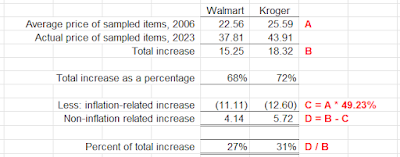

Above is a final summary of the 2023 results. Prices at Walmart increased 68 percent between 2006 and 2023 on our sampled grocery items, approximately 27 percent of which appears to be related to factors other than inflation. At Kroger, (sale) prices jumped 72 percent, 31 percent of which seems non-inflation related. Although not shown in this summary, as noted previously, the ratio of Kroger's prices to Walmart's prices still remains mostly consistent, having slipped just a marginal amount into more expensive territory.

Remember that all of this is a very simplified analysis, and we're not doing any actual further research to determine the truth of what all we just looked at. For instance, we are assuming that profit margins are what's causing the difference -- that is, that the increase in Walmart's and Kroger's prices not accounted for by inflation is simply going straight into their pockets as profit. That may very well be untrue. Profit margins for the retailers may well be unchanged, and there are other factors we are not seeing -- inflation-related, or otherwise -- on the manufacturers' and suppliers' side of things that have caused the additional increase in Walmart's and Kroger's prices. Without gathering tons more evidence -- a lot of which probably isn't even publicly accessible -- and going much more in-depth, we have no way of knowing with absolute certainty. But again... given the limitations and constraints of this particular experiment... we can at least conclude that 1) there definitely appears to be more than just inflation at play in these price increases, and 2) the result of that, absent any evidence to the contrary, is that consumers appear to be giving up more out of their pocket for the same items in 2023 than they did in 2006.

--------------------------------------------------

I was originally intending to write a considerably different blog post today, one that, oh, I don't know, actually involves pictures I took of some retail place in the past, and certainly zero references to my education or my profession (!)... but, clearly, I got sidetracked :P  Even if a lot of this went over your head, I hope you still found the post enjoyable! And if not, well, please accept my apologies, lol. Hopefully I'll be back next month with something a bit more up your alley. Until then and as always, thanks for reading, and have fun exploring the retail world wherever you are!

Retail Retell

Monday, September 25, 2023

Brinkley Kroger: Bauhaus Uncovered!

Today's post highlights Monroe County, AR, retail.

On flickr last week, I started a new album documenting the Searcy, AR, Kroger during its 2021 liquidation sale (inasmuch as a closing Kroger actually "liquidates," but you get the point). As I've discussed at length within that album, Searcy wasn't the only small town in Arkansas to lose its Kroger store in 2021: Kroger also axed its stores in Brinkley, England, DeWitt, and Morrilton, with a final closure across state lines in McComb, MS, to round out the bloodshed for the year. The thing all of these stores had in common were that they were very old locations in (mostly) very small towns; all but two of them, in fact, still had wannabe neon decor, the final ones ever to bear that package chainwide. (Searcy was the only of the six ever to remodel to bountiful/2012 decor, while England has some unidentified package that may even predate Kroger's time in that building.)

Again, all of the details are discussed much further over on flickr, but suffice to say that there have been (somewhat) happy endings for most of these cases... Searcy, DeWitt, Morrilton, and McComb all had other grocery options in town already; McComb's store became a Corner Market (new to town), Morrilton's a Harps (relocating from elsewhere in Morrilton), Searcy's a clothing store, and DeWitt is still vacant (but at least has a Piggly Wiggly in town). Brinkley and England were both set to become food deserts, but Harps came to the rescue in England as well. As for Brinkley... well, wouldn't you know that the Kroger shopping center had actually been owned by competitor Edwards Food Giant since way back in 2013! As such, they were pretty much waiting for Kroger to close all along... they moved really swiftly, too, with Kroger closing on May 29, 2021, and Edwards reopening in the space within mere weeks, on June 19. Even cooler was that Edwards documented its renovation efforts on Facebook... so without further ado, I'd like to share those photos with y'all below!

Courtesy Facebook

We begin with the exterior, where the Kroger signage has been freshly removed (but their cart corral remains).

Courtesy Facebook

Heading inside and looking across to the back left corner, we see a number of the wannabe neon department signs, including Produce, Bread, and Luncheon Meats. We also see Kroger Delta's early 2000s "generic" (non-decor specific) aisle markers, as well as the registers with their original, classic lane light advertisements! Looking quite worse for the wear, of course, but still.

As a refresher of what the store looked like back when Kroger was still open, check out my album from 2017 on flickr here.

Courtesy Facebook

Here comes the fun part: old Bauhaus decor uncovered!! As part of their renovations, Edwards Food Giant (naturally) removed all of Kroger's wannabe neon signage. As it turns out, hiding behind that stuff this whole time has been old, unpainted Bauhaus! This pic takes a look at the deli-bakery area, where much more extensive work was going on below the wall signage, as the entire space was reconfigured (if not expanded, to boot). Kroger's iconic superstore-era staircase spindles used to be located in that small window space.

Courtesy Facebook

Wall decor hadn't yet been removed at the back of the store, but the refrigerated cases were busy being refurbished. As part of their quick turnaround, Edwards did not replace any of the fixtures at this store (except perhaps the produce bins?). These cases are newer than the store's opening anyway (they appear to be from Kroger's millennium decor era, i.e. the early 2000s or so), so most likely they are still in good shape and it wouldn't have made much sense for Edwards to get rid of them.

Courtesy Facebook

Fast-forwarding a bit, we see the product of more decor removal! Old Bauhaus "Produce" and "Bread & Rolls" signs have been uncovered. Compared to "Deli-Bakery," which had yellow text with a red outline, these signs had yellow text with a green outline, meaning this store had a multicolored version of the package. The Stateline Road store in Southaven, MS, famously had a single-colored, pink-and-periwinkle version; meanwhile, the last-ever Bauhaus store, on Spinning Road in Dayton, OH, had an inverted single-color red-and-gray version. There were many, many versions of this decor over the years, it seems like, and I wonder how it was decided which store got which colorations.

Courtesy Facebook

There were two produce signs at this store during the wannabe neon days, and this shot confirms that the same was true in the Bauhaus days. I wonder if this store always had Bauhaus from the beginning, or if it had superstore decor before that.

Courtesy Facebook

Over on the opposite side of the store, the flooring has been torn out, no doubt for work on refrigeration lines and other such plumbing. Above the wall, we find uncovered signage that used to read "Dairy & Ice Cream."

Courtesy Facebook

Despite all the ongoing construction work, a separate crew already began stocking the store's shelves at this time! As I mentioned, Edwards was determined to reopen this store as quickly as possible, and set to work on immediately stocking non-perishable items as a result.

Courtesy Facebook

More stocking is taking place in this photo, where we can also get a good look (as in several of the above images) at the removed drop ceiling tiles. The drop ceiling would soon return, but for now, it's an interesting look!

Courtesy Facebook

Returning a little later, we get a couple of "aerial" views from on top of a construction lift. Definitely a cool perspective here! Stocking is in full swing, and we also get some high-quality views of the uncovered Bauhaus decor.

Courtesy Facebook

Another similar look over to the opposite wall of the store. It's interesting to note how only certain portions of the old Bauhaus walls went unpainted; we can clearly see the outline of the wannabe neon signage extending to either side of the unpainted area, and those "stair-step" portions did see new paint, it appears.

Courtesy Facebook

The restrooms received new plumbing work and upgrades, too, which is nice to see.

Courtesy Facebook

Lower quality pic here, but as promised, we see the drop ceiling returning.

Courtesy Facebook

This shot looks inside what *was* the store's entrance: a tunnel-like area that one entered on the right side of the storefront, under the superstore arches, but forcing customers to walk all the way across the entire front wall to get to produce in the far corner.

Courtesy Facebook

Edwards remedied the situation by relocating the doors front and center on the facade, as seen here. (Same exact doors, too, just moved to a new spot!)

Courtesy Facebook

Our last "birds-eye" view shows us the Bauhaus sign everyone was hoping to see: the "word train" of "Fresh Beef, Pork, & Poultry"! Given that this sign appears to have already been painted over in earlier images, I'm not so certain I'm uploading these in the correct order; in any case, they're all fun to see, regardless.

Courtesy Facebook

It was fun while it lasted, but of course we knew it couldn't last forever; by the time this photo was taken, Edwards had finally painted over the walls, covering over those last Bauhaus decor remnants :(  

Courtesy Facebook

Out front, new concrete was being poured along the front walkway.

Courtesy Facebook

Stocking of the refrigerated cases began in earnest even as the walls were still being repainted!

Courtesy Facebook

A good-looking frozen seafood selection here. I wonder how much Edwards's selection has changed as compared to Kroger's, and their prices, too, for that matter.

Courtesy Facebook

The deli-bakery area was seeing more extensive work, and as such was still covered up by plastic tarps at this point in time. Remember, all of this work happened over the course of only three weeks.

Courtesy Facebook

In the last aisle of the store, we see some fresh new paint colors begin to brighten the place up, including red and yellow. I find the flooring scene here interesting: it looks to me like all the tile was removed in this photo, but as we'll see in later images below, the original Kroger flooring appears to have remained. So I'm not quite sure what I'm looking at here.

Courtesy Facebook

New registers going up at the front of the store; we can also see the relocated entryway. Guest services is straight ahead, with the deli-bakery directly behind that: I wonder if that department expanded into the former entry tunnel corridor any.

Courtesy Facebook

Outside, new signage went up in the spot you'd think it would have been located all along: those iconic superstore arches. It was typical of Kroger not to put their signage here, but doesn't it just make so much more sense to utilize the architecture this way?

Courtesy Facebook

Here's the completed signage: Edwards Food Giant, Since 1959, The Meat People! Notice also the crews bricking over the former entrance area (and if you zoom in close enough, Kroger's yellow "this store is closed" notice in the window, too). 

Courtesy Facebook

Inside, we're very close to reopening, with the walls fully painted, shelves fully stocked, and registers close to being set up. It's funny to note that these "new" registers were brought in secondhand from some other Kroger store, as evidenced by that lane light!

Courtesy Facebook

I wish I had more photos of the finished interior to share with y'all, but alas, this is the only one uploaded to Facebook. In any case, though: it certainly looks like a totally different store!! (Minus the flooring and aisle markers, of course :P )  Edwards did a really good job with this renovation; I'm sure Brinkley is lucky to have them.

Courtesy Google Maps

Last but not least, the completed exterior, as showcased on Google Maps. Below are a few additional images I took while driving through in June of 2021, on the way to the Morrilton store while it was closing (as well as several other retail destinations!)...


I find it strange how the old Kroger logo space was being used simply as home to a very temporary-looking "FOOD GIANT" banner. Hopefully that has been fixed since then. (It does look in the Google Maps photo like they may have gotten new roofing.)


In addition to Kroger's closure in 2021, Fred's (background, right-hand side of this image) closed during the bankruptcy in 2019, so Brinkley had a bit of a tough time for a little while there. However, not only has Kroger been retenanted, but the nearby former Wal-Mart has become a combination Family Dollar/Dollar Tree store... and, Brinkley has gotten a new-build Sonic in the chain's new style, which I found interesting to see. A few more pictures of that follow.


I like that the restaurant still has a letterboard despite also having a high-rise interstate sign. The presence of only the wordmark on that sign actually reminds me a bit of the retro-style Oxford Sonic, even if the rest of the restaurant is totally modern in design.


The drive-in spaces are located exclusively on the right side of the building, with the side facing the street here showing only the drive-thru window (and that giant Sonic logo).


One downside of using the sign shape as a high-rise sign like this is that, for drivers traveling the opposite direction (that is, from town, as opposed to from the interstate), the logo appears backwards. Compare the high-rise sign to the logo on the side of the building in this pic and you'll see what I mean.


One final shot, also showing the newly-opened Edwards Food Giant in the background.

I hope y'all enjoyed this post! I know I certainly got a kick out of stumbling across those Bauhaus images when I did, and I've been waiting for the right time to finally get to share them with y'all as well. I'm not sure right now what or when my next blog post will be, but I do encourage you to keep following me over on flickr, where I continue to upload regularly and where my Searcy Kroger series is just beginning. Stay tuned for more!

Until next time and as always, thanks for reading, and have fun exploring the retail world wherever you are :)

Retail Retell

Sunday, September 17, 2023

Lucky Brand Jeans Closing, Ridgeland, MS

Today's post highlights Madison County, MS, retail.

After an absence from the blog in August (during which I instead was invited over to My Florida Retail for a Q+A session on Aldi's purchase of the Winn-Dixie and Harveys chains from Southeastern Grocers), I am back today with one of (hopefully) two very quick posts for you guys this month. It is September, which means the temperatures are getting cooler -- granted, here in Ridgeland all "cooler" means is 90 degrees as opposed to 108, but still -- and fall is on its way. Fall is my favorite season, and, despite all the encroachment from Halloween and Christmas already, I am excited to celebrate it. Today I put on my favorite pair of Lucky Brand Jeans, and that made me think of the photoset I took a few years ago at the Ridgeland store (before I moved here!) when it was liquidating. So, in that spirit, I thought I'd go ahead and finally share those photos with y'all today. As their jeans say: "lucky you"!


The Ridgeland Lucky store was located in Renaissance at Colony Park, an outdoor lifestyle center featuring a mix of upscale and local retailers and restaurants. Examples include Apple (soon to relocate to a new spot within the same center, actually), Barnes & Noble (the most consistently busy one I've ever seen in my life), and Hallmark (the subject of a future blog post...), among others. There are some vacancies, but nothing too alarming. Lucky's departure came as a result of the company's bankruptcy announcement in 2020; Ridgeland was one of 13 stores immediately selected for closure, which implies to me it must not have done great business. Today, the only Lucky store in Mississippi is an outlet location at Tanger in Southaven.


Heading inside the store, this is it -- the entire salesfloor. Compared to the Southaven outlet location, with which I am much more familiar, Ridgeland struck me as extremely tiny... but then again, perhaps that's typical for their regular/full-line stores. The aesthetic, at least, was similar to what I'm used to from Southaven.


Looking over to the right-side wall, then to the left. Lucky sells both women's and men's apparel, but as you can imagine, women's has a greater selection -- hence, the registers are placed in the center of the left-hand wall, breaking the men's department into two. Women's, on the other hand, spans the entire right-hand wall. I like the American flag decor behind the registers, as well as the pendant lights above.


Looking straight towards the back of the store. In my experience, it is a typical clothing store layout to have the fitting rooms lined up in a singular row hidden behind a "false" back wall, which is exactly what we see here. Even though the walls are almost entirely white, that is not to say they are bland, as I really like the texture added by the wood, moulding, and -- especially -- that unique ceiling. I know some have mixed opinions on concrete floors, but I think the stained concrete here plays nicely with all of those other elements, too.


In the middle of the store, facing towards the back, were these two cool leather chairs. The Southaven outlet store has similar distressed leather couches (which are extremely comfy, by the way!), so I was surprised this much smaller store managed to fit some similar seating in! I'm assuming this is a common Lucky Brand store trait, and I definitely like it -- I would have loved to have purchased something like this for my apartment, but alas, I don't believe the fixtures were for sale quite yet (plus, who knows how expensive they would've been, lol).

Speaking of fixtures -- also take note of the tables behind the chairs. Those are of a unique style, too, and really zero in on the "vintage" vibe Lucky seems to be curating here.


A look at women's apparel in the back right corner, and men's in the back left (well -- men's, plus women's shoes, anyway). These sections were joined by some various posters showing off either generic Lucky Brand imagery (models and locales), or specific jean types (the men's jeans posters were in the front of the store).

I'm curious: do y'all like to wear jeans? They are by far my favorite type of clothing, as long as they are comfortable enough (which may be part of why I like a brand like Lucky, lol). But besides those who prefer shorts, it seems there are a lot of people these days who simply prefer sweatpants or leggings or the like. Where do you fall?


One final shot of the store shows us men's sale denim in the very back, adjacent to the fitting rooms (notice the black-painted wall as opposed to the white walls out in the salesfloor proper). As a Very Thrifty Individual™, you can rest assured that the only jeans I ever purchase from Lucky are from the clearance section, haha! And even with this store's liquidation sales of 30 to 50 percent off, I did not purchase anything on this visit.

Notice the fixtures in stores like this are designed to maximize storage space, and therefore increase the salesfloor and decrease the stockroom: beneath each of the stair steps are pull-out drawers to hold more stock. I've pointed out similar arrangements at other such stores we've visited on the blog, such as the Rockport at Tanger Outlets Southaven.

About a month into its bankruptcy, Lucky successfully sold its business to Sparc Group, the 50-50 partnership between Authentic Brands Group and Simon Property Group, which have snapped up a number of other ailing brands in recent years. Since then, it appears to have been business as usual for the chain -- lucky, indeed.

That's it for this short post; as I mentioned, keep your eyes out for another one later this month, if all goes well. Until then and as always, thanks for reading, and have fun exploring the retail world wherever you are!

Retail Retell